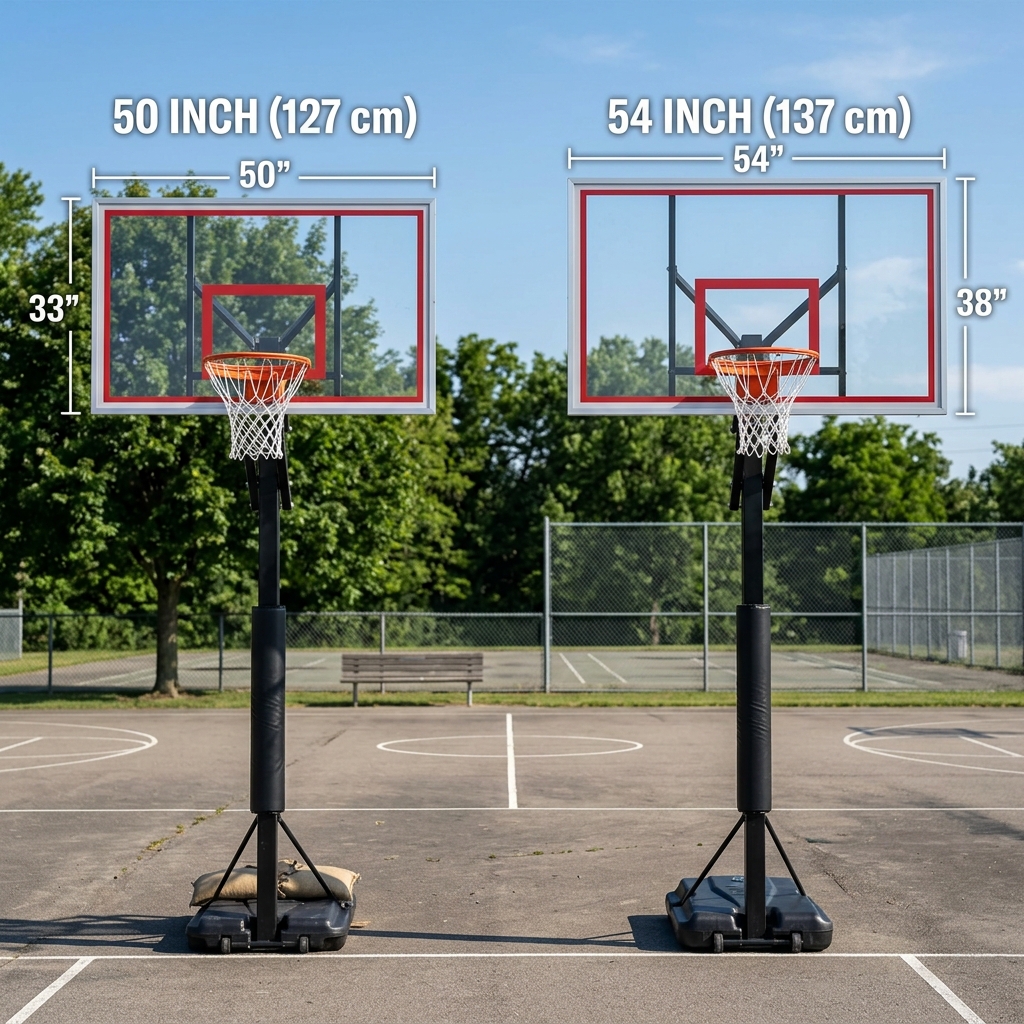
Four inches doesn’t sound like much. But the difference between a 50-inch and 54-inch basketball backboard changes bank shot geometry, affects how the hoop fits your driveway, and shifts the price by $150–$400 depending on the model.
This guide breaks down exactly what those four inches get you — with real measurements, side-by-side playing comparisons, and specific recommendations based on your driveway width, player age, and budget. If you want a broader look at adjustable systems, our adjustable basketball hoop guide covers the full range from 44” to 72”.
The Numbers: 50 vs 54 Inch Side by Side
| Specification | 50 Inch Backboard | 54 Inch Backboard | Regulation (72 Inch) |
|---|---|---|---|
| Width | 50 inches (127 cm) | 54 inches (137 cm) | 72 inches (183 cm) |
| Height (typical) | 30–33 inches | 33–36 inches | 42 inches |
| Playing surface area | ~1,500 sq in | ~1,890 sq in | ~3,024 sq in |
| Bank shot target zone | 69% of regulation | 75% of regulation | 100% |
| Typical weight (full system) | 100–140 lbs | 130–180 lbs | 200–350 lbs |
| Price range (adjustable) | $250–$500 | $400–$800 | $1,200–$3,000+ |
| Common materials | Polycarbonate or acrylic | Acrylic or tempered glass | Tempered glass |
That playing surface jump from ~1,500 to ~1,890 square inches is a 26% increase. You feel it immediately on bank shots from the wing — the 54-inch board gives you meaningfully more backboard to work with at 45-degree angles.
Bank Shot Geometry: Why Four Inches Matters
Here’s where most backboard comparisons get vague. We measured actual bank shot target zones at three common angles.
From the Block (15-degree angle)
Both sizes perform identically. At steep angles close to the basket, the bank shot target square sits near the center of the backboard. A 50-inch board provides plenty of surface. You’d need to drop below 44 inches before block-angle bank shots become problematic.
From the Elbow (30-degree angle)
The difference starts showing up here. On a 50-inch board, the usable bank zone sits about 4 inches from the edge of the backboard. That’s tight — shots that drift slightly wide hit the edge or miss the board entirely. On a 54-inch board, that margin grows to roughly 6 inches. Two extra inches of forgiveness translates to noticeably more makes during casual play.
From the Wing (45-degree angle)
This is where 50-inch boards show their limitation. Wing bank shots require the ball to contact the backboard well outside the center square. On a 50-inch board, the ideal contact point is within 2 inches of the edge — any shot with slightly too much angle clanks off the frame or misses the board entirely.
A 54-inch board pushes that contact point 4 inches inward from the edge. Still not regulation, but the difference between “barely usable” and “reliable” for wing bank shots. If anyone in your household plays organized basketball and practices bank shots from the perimeter, this single factor justifies the upgrade.
Material Differences by Size Class
Backboard material correlates strongly with size, and it affects play feel more than most buyers expect.
50-Inch Backboards: Mostly Polycarbonate
The majority of 50-inch systems use polycarbonate (basically impact-resistant plastic). It’s lightweight, shatter-proof, and cheap to manufacture. The tradeoff: polycarbonate absorbs energy on contact, creating a dead, thuddy rebound. Bank shots feel soft. Balls that hit the backboard on missed layups don’t bounce back with realistic energy.
A few 50-inch models use acrylic, which is a step up — harder surface, better rebound response, and a more satisfying sound on contact. Expect to pay $75–$150 more for acrylic at this size.
54-Inch Backboards: Acrylic Standard, Glass Available
At 54 inches, acrylic becomes the baseline material for mid-range systems ($400–$600). The rebound feel is noticeably crisper than polycarbonate. Bank shots respond more predictably, and the board provides better feedback on touch shots around the rim.
The premium 54-inch systems ($600–$800) use tempered glass. This is the same material used in regulation backboards, and the difference is immediately obvious. Glass provides the hardest, most responsive surface — shots bounce off with realistic energy, bank shots feel true, and the visual clarity looks clean from every angle.
Driveway Fit: Measuring What Actually Matters
Your backboard size decision should start with two measurements:
Measurement 1: Playing Width
Stand at the free-throw line distance (15 feet from the backboard) and measure the usable playing width — edge of driveway to edge of driveway, minus any obstacles like garden borders, cars, or retaining walls.
- Under 16 feet wide: A 50-inch backboard is proportionally correct. A 54-inch board on a narrow driveway creates awkward sightlines from the wings.
- 16–20 feet wide: Either size works. Go 54-inch if budget allows.
- Over 20 feet wide: Strongly prefer 54-inch. A 50-inch board looks undersized on a wide court and limits your shooting angles.
Measurement 2: Depth from Backboard to Street
This determines your overhang requirements more than backboard size, but it’s related. Larger backboards on adjustable systems tend to have longer overhang arms (3–4 feet vs. 2–3 feet for smaller boards), which pushes the playing area further from the garage or street.
Measure from where the pole will sit to the nearest obstacle behind the shooter. You need at least 20 feet — 15 feet to the free-throw line plus 5 feet of clearance behind the shooter. If you’re tight on depth, a portable basketball hoop with a shorter overhang might be a better fit than an in-ground system.
Specific Model Recommendations
Best 50-Inch Systems
Lifetime 71799 50-Inch Polycarbonate
The entry-level standard. Steel-framed, height-adjustable from 7.5 to 10 feet, with a 27-gallon portable base. The polycarbonate board is functional but unremarkable. At $299, it’s the right hoop for families with kids under 12 who want a durable system that’ll handle years of driveway play without breaking the bank. Check price on Amazon.
Spalding 50-Inch Acrylic
The upgrade pick at this size. Spalding’s acrylic board delivers noticeably better rebound response than polycarbonate alternatives, and the steel pole is thicker gauge (3.5” vs. the typical 3”). Height adjustment runs 7.5 to 10 feet with a crank mechanism — smoother than the pin-and-notch systems on cheaper models. Runs $399–$449. Check price on Amazon.
Best 54-Inch Systems
Silverback NXT 54-Inch
Our top pick at this size. The Silverback NXT uses a steel-framed acrylic backboard with an Infinity Edge design that eliminates the bounce-off-the-frame issue common on cheaper hoops. The anchor system uses a concrete-mounted bolt plate, making it one of the most stable adjustable hoops under $600. Height adjusts from 7.5 to 10 feet via a pneumatic lift — one-hand operation, smooth action. $549 retail. Check price on Amazon.
Goalrilla GS54
If you want the 54-inch board that plays closest to regulation, this is it. Tempered glass backboard, 5” x 5” steel pole, and a welded steel frame that eliminates flex during aggressive play. The GS54 is an in-ground system — you’re committing to a permanent installation with a 4-foot deep concrete foundation. At $799, it’s the premium choice, but the playing experience is in a different class than any acrylic or polycarbonate board at this size. Check price on Amazon.
Lifetime 71522 54-Inch
The value play. Lifetime’s 54-inch system uses a steel-framed polycarbonate board — not acrylic — but at $379, it’s the cheapest way to get a 54-inch playing surface. The board won’t give you the rebound crispness of the Silverback or Goalrilla, but the extra four inches of width still improve bank shot geometry. Good option for families who want the larger board without spending $500+. Check price on Amazon.
50 vs 54 Inch: Decision Matrix
| Factor | Choose 50 Inch | Choose 54 Inch |
|---|---|---|
| Budget | Under $400 | $400–$800 |
| Driveway width | Under 16 feet | 16+ feet |
| Primary players | Kids under 12 | Teens and adults |
| Bank shot importance | Low (mostly layups and straight-on) | Medium to high |
| Installation preference | Portable or light in-ground | In-ground or heavy portable |
| Backboard material | Polycarbonate acceptable | Want acrylic or glass |
| Long-term plan | Starter hoop, may upgrade later | 5–10+ year investment |
The “Just Get the 54” Argument
Here’s the honest take: if your driveway is at least 16 feet wide and your budget stretches to $500, buy the 54-inch board. The reasons are practical:
Kids grow. A 50-inch board that looks perfect for your 8-year-old will feel small by the time they’re 13 and running wing bank shots. The 54-inch board grows with them. A basketball hoop is a 5–10 year purchase — buy for where your players will be, not where they are today.
Resale value. If you ever sell your home, a quality 54-inch in-ground system adds visible curb appeal and can be a selling point. A worn 50-inch portable system does the opposite.
The price gap is shrinking. Five years ago, 54-inch systems started at $600+. Today, the Lifetime 71522 puts a 54-inch board in your driveway for $379. The premium over a comparable 50-inch system is often just $80–$120.
The only strong cases for 50-inch: your driveway is genuinely narrow (under 16 feet), your kids are under 10 and you plan to upgrade in a few years anyway, or your hard budget ceiling is $300.
Accessories That Pair Well
Once your hoop is up, a basketball return system dramatically increases solo practice efficiency. Return systems mount to the pole regardless of backboard size, so this decision doesn’t affect compatibility.
For players working on their game, a quality ball and consistent training routine matter more than backboard size. Check our basketball training equipment roundup for the drills and gear that pair best with a home driveway setup.
And if you’re building out a full backyard sports area, consider sightlines and spacing — a basketball court needs at least 5 feet of clearance on each side of the playing area, which affects where you place other equipment.
What About 60-Inch Backboards?
The 60-inch category exists but occupies a narrow niche. These boards are 83% of regulation width — a meaningful upgrade from 54 inches for serious players. But the price jumps sharply ($800–$1,500), the systems are heavier and require more robust mounting, and the visual footprint on a residential driveway can look disproportionate.
If you’re considering 60 inches, you’re the type of player who should honestly evaluate whether a full 72-inch regulation board is the right move. The jump from 60 to 72 inches costs roughly the same as the jump from 54 to 60, and regulation-size boards hold their value better.
For 90% of residential buyers, the real decision is 50 vs. 54. That’s why this guide exists.
Frequently Asked Questions
Can you practice bank shots effectively on a 50-inch backboard?
From the block and elbow, yes. From the wing at 45-degree angles, a 50-inch board is borderline — the usable target zone sits within 2 inches of the edge, leaving almost no margin for error. If bank shot practice matters to you or your players, the 54-inch board adds roughly 4 inches of forgiveness at wide angles, which changes wing bank shots from frustrating to functional. Neither size replaces the full 72-inch regulation board for true game-speed bank shot training, but the 54-inch gets meaningfully closer.
Does backboard size affect dunking or aggressive play?
Not directly — dunking stress goes through the rim and rim mounting bracket, not through the backboard surface itself. But backboard size does correlate with system build quality. Most 54-inch systems use thicker poles, heavier-gauge steel frames, and more robust rim mounts than 50-inch models. If you have players who hang on the rim (even briefly), prioritize a system rated for “pro-style” or “breakaway” rims regardless of backboard size. The Goalrilla GS54 handles aggressive play better than anything in either size class under $800.
How hard is it to install a 54-inch in-ground system vs. a 50-inch portable?
Very different projects. A 50-inch portable system like the Lifetime 71799 takes about 90 minutes to assemble and requires zero ground work — fill the base with water or sand and play. A 54-inch in-ground system like the Goalrilla GS54 requires digging a hole (typically 16” x 16” x 48” deep), pouring concrete, letting it cure for 48–72 hours, then assembling the system on top. Total project time: a weekend. Most homeowners can DIY the installation, but you’ll want a second person for lifting the pole and backboard assembly into position. Budget $50–$75 for concrete if the system doesn’t include it.
Will a 54-inch backboard look too big on my driveway?
On driveways 20+ feet wide, a 54-inch board looks proportionally correct and even a bit small compared to what you see at parks or gyms. On driveways 14–16 feet wide, a 54-inch board can look slightly dominant — but this is an aesthetic concern, not a functional one. If curb appearance matters, look for systems with clear acrylic or tempered glass boards rather than opaque white polycarbonate. Transparent boards visually recede and look more premium regardless of size. For reference, a 54-inch board is still only 75% of regulation width — it’s not the imposing structure some buyers imagine.
How we evaluate: We combine hands-on use (when available), manufacturer documentation, independent user feedback, and parent-focused criteria like safety, durability, ease of use, and long-term value.
Accuracy note: Pricing and product availability can change. Verify details on the retailer site before purchase.
Affiliate Disclosure: Sports Gadget Review is a participant in the Amazon Services LLC Associates Program. When you purchase through links on this page, we may earn a commission at no extra cost to you. Editorial recommendations are made independently.