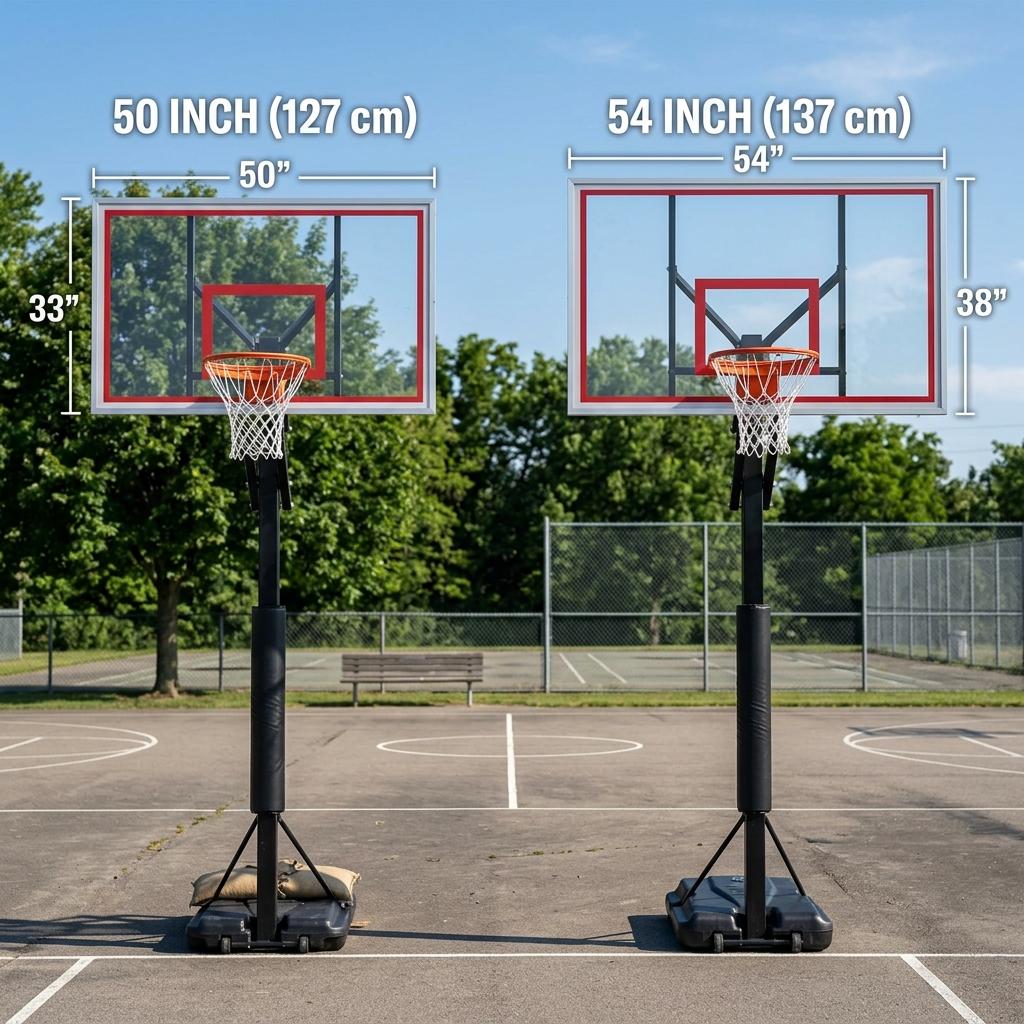
Four inches does not sound like much. But the difference between a 50-inch and 54-inch basketball backboard changes bank shot geometry, affects how the hoop fits your driveway, and can move you into a different price and build-quality class. If you are comparing a 50 vs 54 backboard for home use, understanding how these dimensions affect playability is key to choosing the right system.
For most family driveways, 54 inches is the better long-term size if the driveway is at least 16 feet wide and the hoop will be used by teens or adults. Choose 50 inches when the driveway is narrow, the main players are younger kids, or the budget points you toward a starter portable system.
If you want a broader look at complete systems, our adjustable basketball hoop guide covers portable, in-ground, and youth-height options.
50 vs 54 Backboard: Quick Answer
| Buyer situation | Better pick | Why |
|---|---|---|
| Narrow single-car driveway | 50 inch | Smaller visual footprint and easier fit |
| Normal two-car driveway | 54 inch | Better bank-shot margin without looking oversized |
| Kids under 10 | 50 inch | Good starter size if you expect to upgrade later |
| Teens or adults | 54 inch | More realistic rebounds and wing bank shots |
| Mostly casual layups | 50 inch | Enough board for close-range play |
| Organized players practicing shots | 54 inch | Better long-term training value |
| Permanent in-ground install | 54 inch | Usually better stability and resale appeal |
The Numbers: Side by Side
| Specification | 50 Inch Backboard | 54 Inch Backboard | Regulation Backboard |
|---|---|---|---|
| Width | 50 inches | 54 inches | 72 inches |
| Typical height | 30-33 inches | 33-36 inches | 42 inches |
| Approx. surface area | 1,500 sq in | 1,890 sq in | 3,024 sq in |
| Width vs regulation | 69% | 75% | 100% |
| Common material | Polycarbonate or acrylic | Acrylic or tempered glass | Tempered glass |
| Typical system class | Starter to midrange | Midrange to premium | Premium |
That jump from about 1,500 to about 1,890 square inches is a 26% increase in playing surface. You feel it most on wing bank shots and missed layups where the ball catches the outer third of the board.
Bank Shot Geometry: Why Four Inches Matters
Backboard width matters less on straight-on shots and more as the angle gets wider.
From the block
Both sizes work. Close bank shots use the center of the board, so a 50-inch backboard has enough surface for casual layups, young players, and low-angle practice.
From the elbow
The difference starts showing up. On a 50-inch board, the usable bank zone sits close to the edge. On a 54-inch board, the same shot gets a little more margin. That extra margin is noticeable for kids learning touch and for adults playing casual driveway games.
From the wing
This is where 50-inch boards feel small. Wing bank shots need the ball to hit outside the center square. A 54-inch board does not turn your driveway into a regulation court, but it makes angled bank shots less frustrating and more realistic.
Material Differences by Size
Backboard material often changes as you move up in size.
50-inch systems
Most 50-inch hoops are polycarbonate or entry acrylic. Polycarbonate is durable and shatter-resistant, but rebounds feel softer. It is fine for kids, casual shooting, and rough outdoor use.
Acrylic at this size is a step up. It gives a cleaner look and a slightly crisper rebound, though it still will not feel like glass.
54-inch systems
At 54 inches, acrylic becomes common and tempered glass becomes more available. Acrylic is the practical middle ground for families. Tempered glass is the better training surface because rebounds feel firmer and more predictable.
If older players will use the hoop several times per week, backboard material matters almost as much as width.
Driveway Fit: Measure Before You Buy
Start with driveway width. Stand where the free throw line would be, then measure the usable playing width after subtracting cars, walls, landscaping, and garage edges.
- Under 16 feet wide: Choose 50 inches unless the driveway is very open.
- 16-20 feet wide: Either works, but 54 inches is the better long-term buy.
- Over 20 feet wide: Prefer 54 inches or larger.
Next, measure depth. You need room for the hoop base or pole, the free-throw distance, and a few feet behind the shooter. If space is tight, a portable basketball hoop may fit better than a permanent in-ground system.
Best 50-Inch Hoop Options
Lifetime 50-Inch Portable Systems
A Lifetime-style 50-inch portable hoop is the starter family pick. Look for an adjustable rim, a fillable base, and a polycarbonate or acrylic board. This class is best for kids under 12, narrower driveways, and families that may upgrade later.
Check current 50-inch Lifetime hoop options on Amazon
Spalding 50-Inch Acrylic Systems
If you want the smaller size but better rebound feel, look for a 50-inch acrylic system from Spalding or a similar brand. Acrylic is a meaningful upgrade over basic polycarbonate while keeping the footprint manageable.
Compare 50-inch acrylic basketball hoops on Amazon
Best 54-Inch Hoop Options
Silverback NXT 54-Inch
The Silverback NXT class is a strong fit for families who want a better 54-inch hoop without jumping all the way to a premium glass in-ground system. The design is cleaner and more stable than most starter portable hoops.
Check current Silverback NXT 54-inch options on Amazon
Goalrilla GS54
If you want the 54-inch board that plays closest to a gym setup, look at a Goalrilla GS54-style in-ground system. The tempered-glass board, heavier pole, and permanent anchor make it a better fit for serious driveway practice.
Check current Goalrilla GS54 options on Amazon
Lifetime 54-Inch Portable Systems
A Lifetime 54-inch portable hoop is the value play if you want the larger board without a permanent install. Check the listing carefully because some versions are polycarbonate and some are acrylic.
Compare Lifetime 54-inch portable hoops on Amazon
50 vs 54 Backboard Decision Matrix
| Factor | Choose 50 Inch | Choose 54 Inch |
|---|---|---|
| Driveway width | Under 16 feet | 16+ feet |
| Primary players | Kids under 12 | Teens and adults |
| Bank shots | Mostly close-range | Wing and elbow bank shots matter |
| Installation | Portable starter hoop | Better portable or in-ground hoop |
| Material expectation | Polycarbonate acceptable | Prefer acrylic or glass |
| Long-term plan | Starter hoop | 5-10+ year system |
Why 54 Inches Is Often Worth It
If the driveway fits it, the 54-inch board is usually the better buy. Kids grow, older players benefit from a wider target, and the hoop is likely to sit in the driveway for years.
The 50-inch board still has a place. It is easier to fit, easier to justify for younger kids, and often the right move when you are buying a first hoop rather than a long-term training setup.
Accessories That Pair Well
Once your hoop is up, a basketball return system can dramatically increase solo practice efficiency. Return systems mount near the hoop and are usually independent of whether you picked a 50-inch or 54-inch board.
For players working on their game, a quality ball and consistent routine matter more than backboard size. Check our basketball training equipment roundup for the drills and gear that pair best with a driveway hoop.
And if you are building out a full backyard sports area, consider sightlines and spacing before placing other equipment near the court.
What About 60-Inch Backboards?
The 60-inch category is worth considering for serious players with a wide driveway or dedicated court pad. It is a meaningful upgrade from 54 inches, but the systems are heavier, more expensive, and more visually dominant.
For most residential buyers, the practical decision is still comparing a 50 vs 54 backboard. Go 60 only when you have the space, budget, and player skill level to justify it.
Frequently Asked Questions
Can you practice bank shots effectively on a 50-inch backboard?
From the block and elbow, yes. From the wing, a 50-inch board is more limiting because the useful target area sits closer to the edge. If bank-shot practice matters, a 54-inch board is the better choice.
Does backboard size affect dunking or aggressive play?
Not directly. Dunking stress goes through the rim and rim mount, not just the backboard surface. But larger systems often have stronger poles, frames, and rim mounts, so build quality matters more than width alone.
How hard is it to install a 54-inch in-ground hoop compared with a 50-inch portable hoop?
A 50-inch portable hoop is usually an assembly-and-fill project. A 54-inch in-ground hoop requires location planning, a concrete footing, cure time, and at least two people for safe assembly.
Will a 54-inch backboard look too big on my driveway?
On a normal two-car driveway, a 54-inch board usually looks proportional. On a narrow single-car driveway, it can look dominant, especially if the board is opaque instead of clear acrylic or glass.
Sources Checked
How we evaluate: We combine hands-on use (when available), manufacturer documentation, independent user feedback, and parent-focused criteria like safety, durability, ease of use, and long-term value.
Accuracy note: Pricing and product availability can change. Verify details on the retailer site before purchase.
Affiliate Disclosure: Sports Gadget Review is a participant in the Amazon Services LLC Associates Program. When you purchase through links on this page, we may earn a commission at no extra cost to you. Editorial recommendations are made independently.