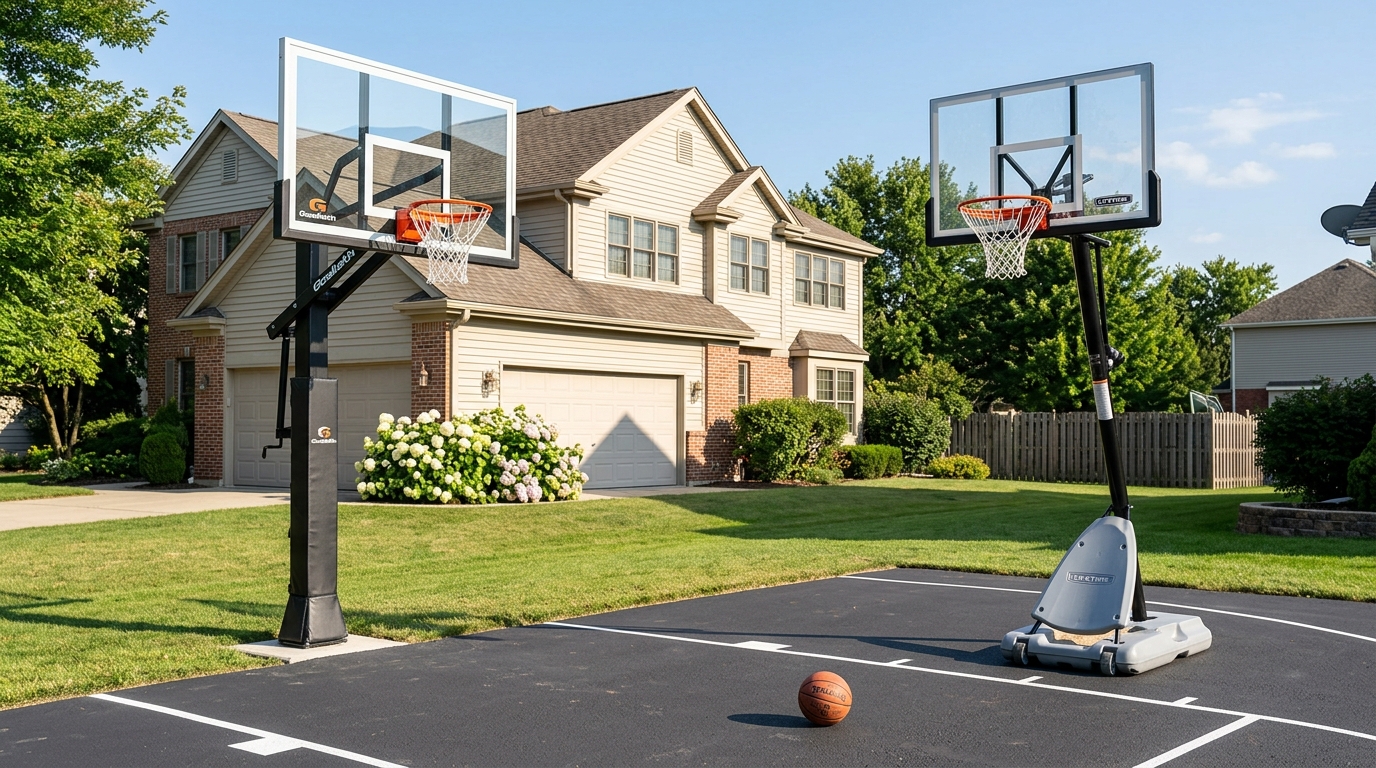
For families, teens, and serious players looking to bring the court home, choosing a basketball hoop is a major decision. It is not just about the cost of the system; it is about how the hoop affects the safety of your children, the visual appeal of your home, the usability of your driveway, and the overall quality of play.
The primary decision point for most buyers comes down to a fundamental choice: in-ground vs portable basketball hoops.
An in-ground hoop offers unmatched stability, gym-like rebounds, and a permanent anchor in your driveway. A portable hoop offers flexibility, instant playability, and the ability to pack up and move the system if you relocate or need to clear the driveway. In recent years, both options have been enhanced by adjustable height mechanisms that let you raise and lower the rim to accommodate players of different ages and skill levels.
In this guide, we will break down the structural, financial, and practical differences between these two systems to help you choose the best basketball setup for your home.
In-Ground vs Portable Hoops: Quick Comparison
Before diving into the details, here is a high-level look at how these two types of hoop systems stack up across key categories:
| Feature | In-Ground Basketball Hoops | Portable Basketball Hoops |
|---|---|---|
| Stability | Exceptional (rock-solid, minimal shake) | Moderate (susceptible to wobble & vibration) |
| Installation | Complex (digging hole, concrete pouring, curing) | Easy (box assembly, fill base with water/sand) |
| Mobility | Permanent (unless using bolt-anchor systems) | Mobile (wheeled base can roll into garage/yard) |
| Safety | High (securely anchored in ground) | Moderate (can tip in heavy winds or on dunks) |
| Rebound Quality | Gym-like (especially with tempered glass) | Softer (base and poles absorb rebound energy) |
| Driveway Footprint | Small (minimal pole footprint) | Large (plastic base takes up 3-4 feet behind rim) |
| Typical Price | Higher ($500 - $2,000+) | Lower to Midrange ($150 - $1,500) |
| Lifespan | Long-term (10-20+ years) | Short-to-Medium (3-10 years) |
Defining the Options: In-Ground, Portable, and Adjustable Systems
To make an informed decision, it helps to understand what makes each system unique and where their features overlap.
What is an In-Ground Basketball Hoop?
An in-ground hoop features a vertical steel post that is permanently anchored into a deep concrete footing in the ground. The most modern systems do not bury the pole directly in concrete; instead, they use an anchor bolt kit. You pour the concrete and set a steel anchor plate with J-bolts. Once cured, the main pole bolts onto this plate. This design provides maximum rigidity and has a major secondary benefit: if you move houses, you can unbolt the hoop and take it with you, leaving only the concrete pad behind.
What is a Portable Basketball Hoop?
A portable hoop is a self-contained system. It features a heavy plastic base equipped with wheels, a main vertical pole, a backboard, and a rim. The stability of the hoop depends entirely on the weight inside the plastic base. Buyers fill the base with water, sand, or specialized base-gel polymers to keep the system upright. Because the base has built-in wheels, you can tilt the system and roll it to a different location, such as into a garage for winter storage or out of the way for driveway parking.
What is an Adjustable Basketball Hoop?
An adjustable basketball hoop is not a third category, but rather a mechanical feature found on both in-ground and portable systems. It refers to a lift mechanism—such as a threaded crank actuator or a spring-assisted trigger handle—that allows users to change the rim height. Most residential systems adjust from 7.5 feet up to the regulation 10 feet.
If you are looking for the absolute best performance, our best adjustable basketball hoops guide covers the top systems across both portable and in-ground styles, while our best driveway adjustable basketball hoops guide goes deep into solving stability issues.
Stability and Rebound Performance (The “Wobble” Factor)
The single biggest difference in actual playability between in-ground and portable hoops is stability.
Why Portable Hoops Wobble
When a basketball hits the rim or backboard of a portable hoop, the energy of the impact travels down the pole and into the plastic base. Because the base is filled with liquid or sand and rests on top of the driveway surface rather than inside it, the system flexes and sways. This vibration is known as the “wobble.”
Excessive wobble can make shooting practice frustrating. A ball hitting the rim on a shaky portable hoop causes the rim to vibrate for several seconds, altering the bounce of subsequent shots and making realistic rebounding practice difficult.
The In-Ground Solution
In-ground hoops eliminate the wobble factor by routing impact forces directly into a concrete foundation. A thick, single-piece steel pole (typically 5x5 inches or 6x6 inches) anchored in concrete absorbs the shock of a hard bank shot or dunk instantly. The rim remains steady, providing the exact rebound response you would experience in a school gym or indoor court.
Backboard Material Matters
The backboard material also plays a massive role in stability and playability.
- Tempered Glass: The gold standard for rebounds. It is heavy, rigid, and provides a crisp, predictable bounce. Because glass is heavy, it requires the structural support of an in-ground pole or a very high-end portable frame to prevent shaking.
- Acrylic: A common midrange material. Acrylic backboards look like glass and offer decent rebound performance, but they are lighter and flex more under impact.
- Polycarbonate: Highly durable and virtually shatterproof, polycarbonate is the default choice for budget portable hoops. However, it acts like a drumhead, absorbing rebound energy and producing a soft, dead bounce.
For a detailed look at how backboard size and geometry affect your driveway setup, refer to our 50 vs 54 backboard comparison.
Installation: Concrete Pours vs. Fast Assembly
The ease of setup is a primary reason why many buyers default to portable hoops.
Portable Hoop Setup: Quick and Independent
Setting up a portable hoop is a straightforward, though sometimes tedious, assembly project.
- Assembly: You bolt the frame, pole, lifting mechanism, backboard, and rim together using standard hand tools. This typically takes 2 to 4 hours.
- Filling the Base: Once assembled, you roll the hoop to its designated spot and fill the base. Water is the easiest option, but it can freeze and crack the plastic in winter, or slowly evaporate. Sand is heavier and more stable, but it is difficult to pour through the small fill holes.
- Play Time: The hoop is ready for play the same day it arrives.
If you have decided that a portable system is the right fit, check out our reviews of the best portable basketball hoop for driveway.
In-Ground Hoop Setup: A Multi-Day Project
Installing an in-ground hoop requires physical labor, specialized tools, and patience.
- Utility Check: Before digging, you must call local utility locators (such as 811) to ensure you will not hit gas, water, or electric lines.
- Digging the Hole: You must dig a hole that is typically 3 to 4 feet deep and 18 to 24 inches wide.
- Pouring Concrete: You will need between 8 and 12 bags of concrete mix. You pour the concrete into the hole, insert the anchor bolts or pole sleeve, and level the mounting plate.
- Curing Time: The concrete must cure for at least 72 hours before it can support the weight of the hoop.
- Assembly & Mounting: Because in-ground hoops use heavy steel poles and tempered glass boards, lifting the main pole and mounting the backboard requires at least two or three strong adults.
Safety, Durability, and Environmental Risks
Driveway hoops must withstand aggressive play and severe weather.
Tipping Hazards and Wind Resistance
Portable hoops are vulnerable to high winds. A strong storm can blow over a portable hoop, especially if the base is not fully filled or has a slow leak. When a portable hoop tips forward, the heavy backboard and rim can crash into parked cars, garage doors, or worse, strike a person.
In contrast, an in-ground hoop is engineered to handle wind loads of 50 to 70+ mph without budging.
The Danger of Dunking
Every kid wants to dunk like their favorite professional players. Hanging on the rim of a portable basketball hoop is extremely dangerous. The forward pull of a player’s body weight shifts the center of gravity, causing the entire plastic base to lift off the ground and tip forward.
Premium in-ground hoops are specifically designed to handle dunking. They feature heavy steel break-away rims with dual compression springs that absorb vertical force, transferring the stress into the concrete-anchored pole rather than the backboard.
Driveway Spacing and HOA Rules
Before making a purchase, you must evaluate the physical space of your driveway and check local regulations.
Usable Driveway Space
A portable hoop has a large physical footprint. The plastic base behind the pole is typically 4 to 5 feet long and 3 feet wide. This base takes up valuable driveway space, pushing the actual court area forward. If you have a short driveway, a portable base can force players closer to the street.
An in-ground hoop has a minimal footprint. The pole occupies a single square foot of space right at the edge of the grass or driveway. This allows you to position the backboard closer to the edge, maximizing the usable playing area in front of the rim.
HOA and Municipal Rules
Many Homeowners Associations (HOAs) and municipal codes have strict rules regarding basketball hoops.
- Permanent Bans: Some HOAs strictly forbid permanent, in-ground hoops to maintain a uniform neighborhood aesthetic.
- Storage Rules: Other HOAs allow portable hoops but require them to be rolled out of sight (such as into the backyard or garage) when not in use. Always check your neighborhood bylaws before investing in an in-ground installation.
Featured Product Reviews
To help you choose, we have highlighted three top-performing systems that represent the best of in-ground stability, premium portability, and entry-level value.
1. Goalrilla FT54 In-Ground Basketball Hoop
The Goalrilla FT54 is our top recommendation for serious players who want gym-quality play at home. It features a 54-inch tempered glass backboard, a rock-solid 5x5 inch one-piece steel pole, and Goalrilla’s signature J-bolt concrete anchoring system.
 Editor's Choice
 Goalrilla
Goalrilla FT54 In-Ground Basketball Hoop
Gym-quality tempered glass rebound and a rock-solid, wobble-free anchor system.
Pros
- + Thick tempered glass backboard gives professional, predictable rebounds
- + J-Bolt anchor system allows the hoop to be unbolted and moved to a new home
- + Heavy-duty single-piece steel pole eliminates joint-wobble
- + Smooth crank actuator allows easy height adjustment from 7.5 to 10 feet
Cons
- − Requires digging and concrete pouring
- − Higher upfront investment
2. Spalding The Beast Portable Basketball Hoop
If you want the performance of glass but cannot install a permanent hoop, Spalding The Beast is the ultimate portable solution. It features a massive 60-inch tempered glass backboard and a 50-gallon base that provides unmatched stability for a wheeled system.
 Best Premium Portable
 Spalding
Spalding The Beast Portable Basketball Hoop
Large 60-inch tempered glass backboard and a massive 50-gallon base for maximum portable stability.
Pros
- + Tempered glass backboard provides excellent rebound performance
- + Huge 50-gallon base significantly reduces wobble compared to budget portables
- + Easy-to-use jack-style lift mechanism
- + Sturdy multi-wheel chassis for easier movement
Cons
- − Heavy and difficult to move once base is filled (weighs 300+ lbs)
- − Assembly is highly complex and requires multiple adults
3. Silverback NXT 54 Portable Basketball Hoop
The Silverback NXT 54 offers a fantastic middle ground for families. Its Stabili-Frame design connects the steel pole directly to the wheel chassis, creating a steel-on-steel connection that eliminates the typical base-shake found in budget hoops.
 Best Value Portable
 Silverback
Silverback NXT 54 Portable Basketball Hoop
Innovative Stabili-Frame design provides superior stability for a mid-range portable hoop.
Pros
- + Stabili-Frame frame construction transfers energy directly to the ground
- + Infinity Edge backboard design provides a clean look and added rigidity
- + Quick-Play design cuts assembly time down to under 2 hours
- + Ergonomic height adjustment handle
Cons
- − Acrylic backboard rebound is softer than tempered glass
- − Large base takes up substantial space behind the rim
Verdict & Buying Recommendations
Choosing the Right Driveway Hoop
Our Verdict
For the absolute best play experience, long-term durability, and safety, go with an in-ground hoop like the Goalrilla FT54. Its tempered glass board will not scratch or yellow, and the J-bolt concrete anchor eliminates the frustrating wobble of portable bases. However, if you rent your home, face strict HOA guidelines that ban permanent structures, or need the flexibility to move your court setup, invest in a premium portable system like Spalding The Beast or the innovative Silverback NXT.
Sports Gadget Review Editors
Frequently Asked Questions
Is it safe to dunk on a portable basketball hoop?
No. Hanging on the rim of a portable hoop is highly dangerous. Tipping the system over can cause severe injury, damage to the hoop, and damage to property. Only perform dunks on high-quality, concrete-anchored in-ground hoops with spring-loaded breakaway rims.
What is the best way to fill a portable hoop base?
Water is the easiest to fill and empty, but it can leak, evaporate, or freeze and crack the base in winter. Sand is heavier and provides better stability, but is very difficult to empty if you move. A great alternative is water mixed with a base gel polymer, which turns the liquid into a heavy, freeze-resistant gel that won't leak easily.
How deep must an in-ground basketball hoop pole be placed?
Most premium in-ground hoops require a concrete footing that is 3 to 4 feet deep and 18 to 24 inches wide. This depth is critical to get below the frost line and provide enough leverage to support the heavy steel and glass structure.
Can I take my in-ground basketball hoop with me when I move?
Yes, if you choose a system with a bolt-down anchor plate (like Goalrilla, Silverback, or Pro Dunk). You unbolt the pole from the J-bolts embedded in the concrete, purchase a new anchor plate kit for your new home, and pour a new concrete footing there.
Sources & References
How we evaluate: We combine manufacturer documentation, independent user feedback, and parent-focused criteria like safety, durability, ease of use, and long-term value.
Accuracy note: Pricing and product availability can change. Verify details on the retailer site before purchase.
Affiliate Disclosure: Sports Gadget Review is a participant in the Amazon Services LLC Associates Program. When you purchase through links on this page, we may earn a commission at no extra cost to you. Editorial recommendations are made independently.