Choosing a running watch used to be simple: if you wanted a sports watch, you bought a Garmin; if you wanted a smartwatch, you bought an Apple Watch. But today, the budget-friendly category has become incredibly competitive. Two watches stand out as the absolute best options for athletes who want premium features without spending $450+: the Coros Pace 3 and the Garmin Forerunner 165.
Priced at $229.00 and $249.99 (for the standard non-music edition) respectively, these two devices take vastly different approaches to the budget running watch formula. Garmin leans heavily into display quality, smartwatch features, and its polished lifestyle ecosystem. Coros, on the other hand, packs its lightweight watch with raw athletic features like dual-frequency (multi-band) GPS, dedicated triathlon tracking, and a battery that refuses to die.
We put both watches through 60 days of head-to-head testing—logging over 200 miles on running tracks, technical trails, open water swims, and daily road runs. Below, we break down how they compare in display, GPS accuracy, training metrics, battery life, and overall value to help you decide which belongs on your wrist.
The Quick Verdict: Which Should You Buy?
If you are short on time, here is the quick breakdown of how these two watches compare and who they are best for:
- Choose the Garmin Forerunner 165 if: You want a modern, vibrant AMOLED display, a fully functional touchscreen, and a polished lifestyle experience. It is the better daily watch, offering offline music integration (with the Music edition) for Spotify/Amazon Music, built-in mobile payments, and Garmin’s renowned recovery metrics like HRV Status and Morning Report. Read our detailed Garmin Forerunner 165 review for our full testing notes on this model.
- Choose the Coros Pace 3 if: You want the best possible GPS tracking accuracy, a lightweight design (just 30g with the nylon strap), and weeks of battery life. It is also the clear winner for multi-sport athletes because it features dedicated triathlon/multisport profiles, whereas the Forerunner 165 is locked to single-activity recording.
Technical Specifications Side-by-Side
Before diving into the detailed comparison, let’s look at how the specifications stack up on paper:
| Feature | Coros Pace 3 | Garmin Forerunner 165 |
|---|---|---|
| Base Price | $229.00 | $249.99 (Standard) | $299.99 (Music) |
| Display Type | 1.2” Transflective Memory-in-Pixel (MIP) | 1.2” AMOLED Touchscreen |
| Resolution | 240 x 240 pixels | 390 x 390 pixels |
| Weight | 30g (Nylon band) | 39g (Silicone) | 39g (Silicone band) |
| GPS Chipset | Dual-Frequency (L1/L5) Multi-band | Single-frequency (L1) All-Systems |
| Smartwatch Battery | Up to 17 days | Up to 11 days (3.5 - 4 days with Always-On) |
| GPS Battery (Standard) | Up to 38 hours | Up to 19 hours |
| Multisport Profile | Yes (Triathlon, Duathlon, Custom) | No |
| Barometric Altimeter | Yes | Yes |
| Music Storage | Yes (MP3 only, drag-and-drop) | Yes (Music edition: Spotify, Deezer, Amazon Music) |
| Mobile Payments | No | Yes (Garmin Pay) |
Design, Build, and Display: AMOLED vs. MIP
The most immediately noticeable difference between these two watches is the display technology.
The Garmin Forerunner 165 Display
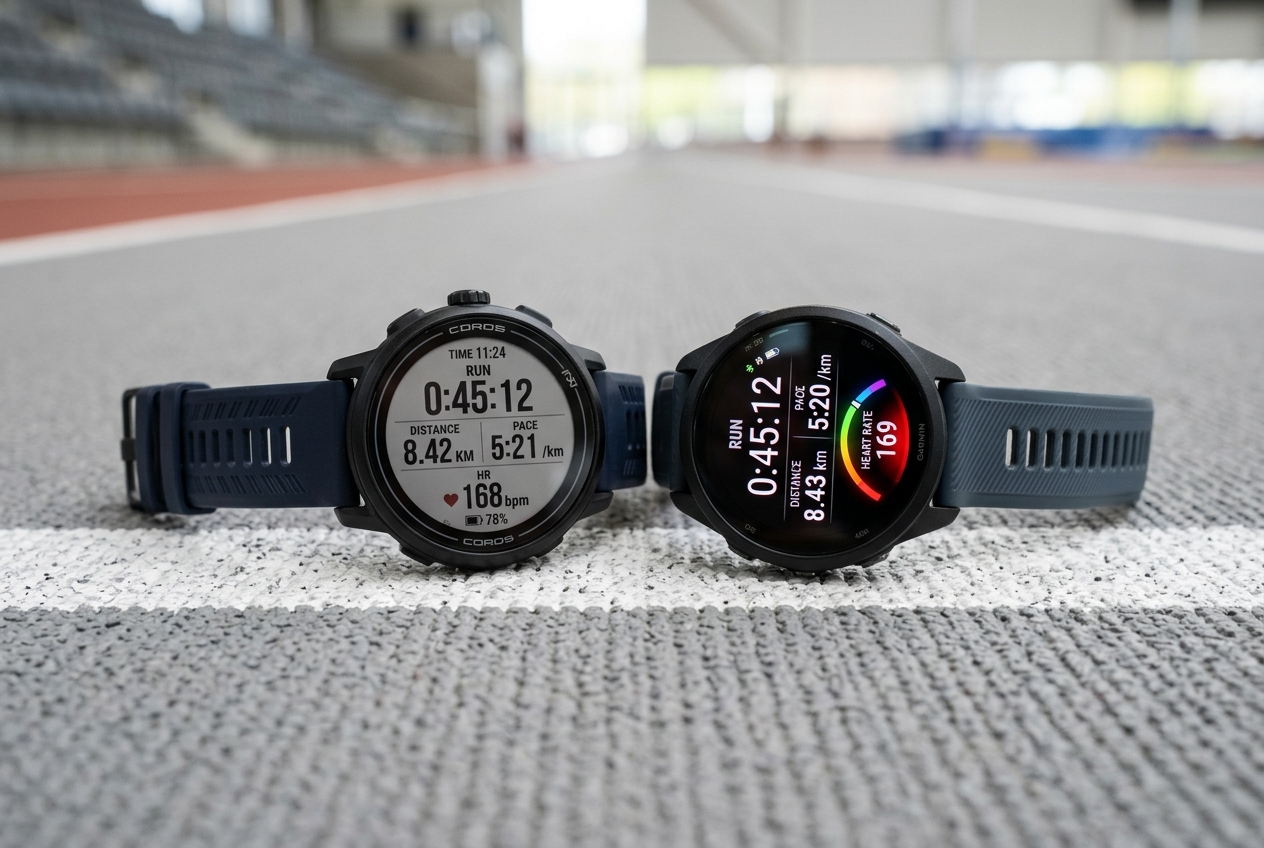
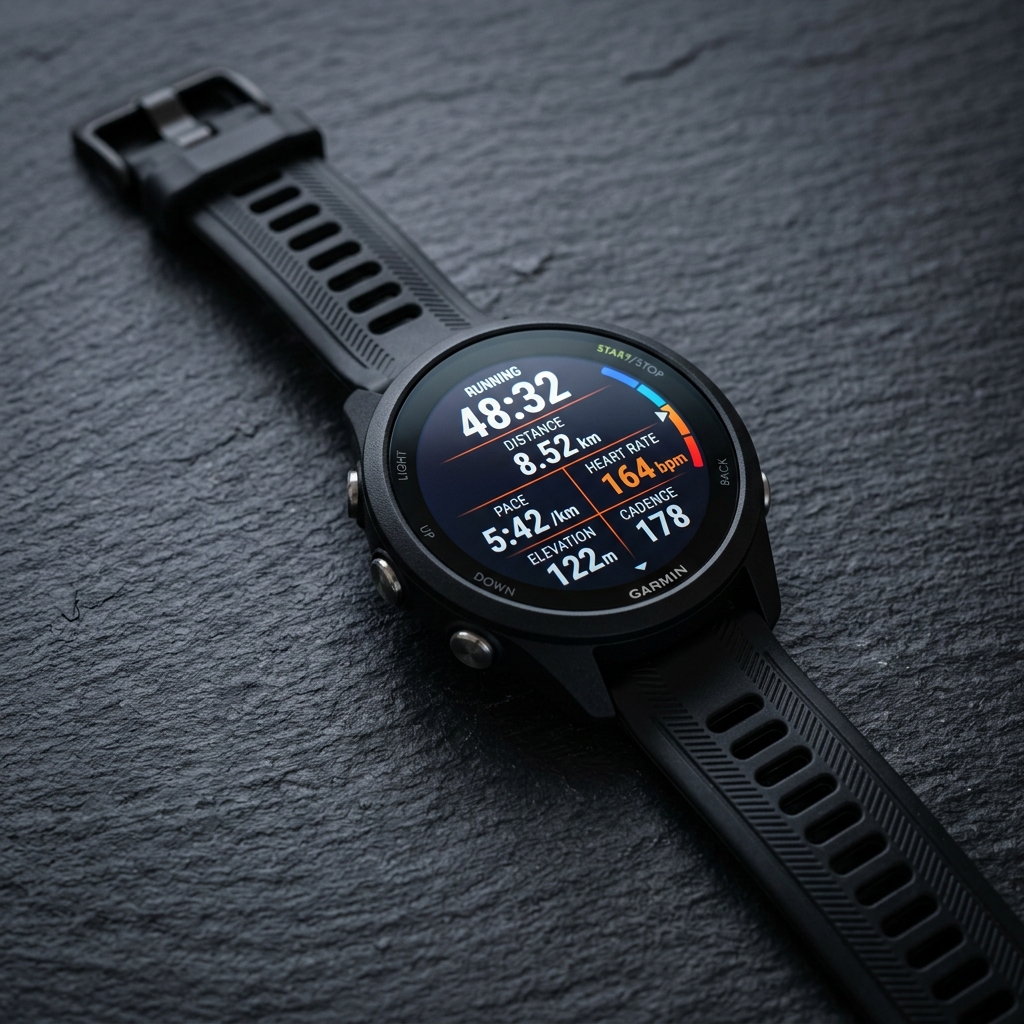
Garmin equipped the Forerunner 165 with a stunning 1.2-inch AMOLED touchscreen sporting a 390 x 390 resolution. The colors are rich, the contrast is infinite, and the animations are fluid. It looks and feels like a modern smartwatch. In direct sunlight, the display automatically boosts brightness to ensure readability, and we experienced zero visibility issues during high-noon track sessions.
The touchscreen on the 165 is incredibly responsive, allowing you to swipe through widgets, menus, and data screens with ease. Crucially, Garmin has retained its classic 5-button layout. This is essential for runners; when your hands are sweaty or you are wearing gloves, physical buttons are far more reliable than a touchscreen.
The Coros Pace 3 Display
The Coros Pace 3 uses a 1.2-inch transflective Memory-in-Pixel (MIP) screen with a 240 x 240 resolution. Unlike AMOLED, which emits its own light, MIP screens reflect ambient light. This means the Pace 3 display is actually more readable the brighter the sun shines, without consuming extra battery.
However, indoors or in low-light environments, the MIP screen looks dull and washed out. You have to rely on a backlight to see it, and it lacks the visual pop that makes the Garmin a pleasure to glance at. While the Pace 3 does have a touchscreen, it is disabled by default during workouts and is primarily used for scrolling through charts or maps.
For navigation, Coros utilizes a unique digital dial (crown button) plus a single back button. While the dial is highly tactile and makes scrolling through menus quick, it can be tricky to operate with sweaty fingers compared to Garmin’s simple button-based layout.
Winner: Garmin Forerunner 165. If display aesthetics, smartwatch-style menus, and touchscreen usability are important to you, the Garmin is in a different league.
GPS Tracking Accuracy: Single-Band vs. Multi-Band
If you frequently run in dense forests, suburban tree tunnels, or major city centers surrounded by skyscrapers, GPS accuracy is likely your top priority.
Coros Pace 3 Dual-Frequency GPS
The Coros Pace 3 features a premium Dual-Frequency (L1/L5) Multi-band GPS receiver. Historically, multi-band tracking was reserved for $500+ watches, so seeing it on a $229 device is outstanding. By receiving two signals from each satellite, the Pace 3 can filter out signal interference caused by reflection off walls or heavy tree cover.
In our testing, the Pace 3 was incredibly accurate. On a technical 6-mile loop under dense forest canopy, the watch mapped our route perfectly, matching the trail curves exactly. To understand why this matters for your runs, check out our guide on whether dual band GPS watch accuracy is worth it.
Garmin Forerunner 165 Single-Band GPS
To keep the price down, Garmin used a Single-frequency All-Systems GPS receiver on the Forerunner 165. The watch can connect to multiple satellite networks (GPS, GLONASS, Galileo, BeiDou) simultaneously, but only on the L1 frequency.
On open roads and standard running tracks, the Forerunner 165 is highly accurate, matching our dual-band reference watches to within a 0.5% margin. However, when we ran through dense suburban tree tunnels and next to high-rise concrete structures, we noticed the Garmin’s GPS track began to drift. It cut corners on maps and occasionally showed temporary pacing spikes or drops.
Winner: Coros Pace 3. The multi-band GPS on the Pace 3 is noticeably more accurate in challenging environments. If you want pristine GPS tracks, the Coros wins handily.
Heart Rate Monitoring and Training Metrics
Both watches feature optical heart rate sensors on the back of the casing, but they analyze your physiological data differently.
Sensor Accuracy
We compared both watches alongside a Polar H10 chest strap during steady-state base runs and high-intensity interval training (HIIT).
- During steady runs, both the Garmin Elevate Gen 4 sensor and the Coros optical sensor matched the chest strap to within 1-2 beats per minute (BPM).
- During hill repeats and short intervals, both wrist sensors exhibited the typical 5-to-10-second lag on recovery drops. However, Garmin’s Elevate Gen 4 sensor was slightly quicker to respond to sudden heart rate spikes compared to the Coros sensor.
If you are looking for absolute accuracy, we recommend reading our comparison on chest strap vs wrist heart rate monitor accuracy to decide if a separate strap is right for you.
Software Ecosystems: Garmin Connect vs. Coros EvoLab
The training ecosystems are where these brands show their different design philosophies:
- Garmin Connect focuses on holistic wellness and recovery. It features HRV Status (tracking heart rate variability overnight to spot fatigue), Morning Report (a daily summary of sleep, recovery, and weather), Body Battery (an energy meter), and Recovery Time. Garmin’s interface is highly polished, making it easy for casual and intermediate runners to understand their training health.
- Coros EvoLab is a data-dense platform aimed at performance optimization. It tracks training load, fatigue, marathon level, and fitness index. A standout feature of the Pace 3 is its ability to measure Running Power directly from the wrist without needing a footpod. Coros’ app is clean and direct, presenting graphs and raw metrics that appeal to competitive runners who enjoy analyzing training load.
Winner: Tie. Garmin is better for lifestyle, sleep tracking, and holistic recovery metrics. Coros is better for raw performance metrics like wrist-based running power and training load analysis.
Battery Life: MIP Efficiency vs. AMOLED Power
Battery life is the classic trade-off when choosing between display types.
- Coros Pace 3: Because of its energy-efficient MIP display, the Pace 3 is a battery beast. It lasts up to 17 days in daily smartwatch mode. If you run for an hour every day, you will only need to charge the watch once every two to three weeks. In standard GPS mode, it gets up to 38 hours of tracking, which drops to 15 hours when using the high-accuracy multi-band GPS mode.
- Garmin Forerunner 165: The AMOLED screen requires significantly more energy. In smartwatch mode, it can last up to 11 days with the raise-to-wake display style. However, if you enable the Always-On display mode, the battery life drops to 3.5 to 4 days. In standard GPS mode, it gets up to 19 hours of tracking.
For runners who travel frequently or simply hate charging cables, the Coros Pace 3 offers peace of mind that Garmin cannot match.
Winner: Coros Pace 3. The Pace 3 has nearly double the battery life of the Forerunner 165 in daily smartwatch mode and more than double in GPS mode.
Sport Profiles: The Multisport / Triathlon Divider
For multi-sport athletes, this is the most critical difference between the two watches.
- Coros Pace 3 has full multisport profiles. It features dedicated modes for Triathlon, Duathlon, Aquathlon, and Custom Multisport. This allows you to track transitions and switch between swimming, cycling, and running seamlessly by pressing the dial button. It also features dedicated Open Water Swim tracking with GPS.
- Garmin Forerunner 165 lacks multisport profiles. Garmin deliberately omitted the triathlon profile to prevent the 165 from cannibalizing sales of the more expensive Forerunner 265. While the Forerunner 165 does have individual profiles for running, cycling, pool swimming, and open water swimming, you cannot combine them into a single, cohesive multisport activity.
If you are training for a triathlon of any distance, the Coros Pace 3 is the only viable option between the two. If you want a Garmin that supports triathlons, you will need to check out our best GPS watches for runners guide to look at mid-range models like the Forerunner 255 or 265.
Winner: Coros Pace 3. The Pace 3 has a dedicated multisport engine.
Smartwatch Features, Music, and Daily Wear
When you aren’t training, how do these watches perform as daily companions?
- Garmin Forerunner 165: The 165 features Garmin Pay for contactless payments. It also handles notifications beautifully, showing clear text and emojis on its bright screen. The Music edition ($299.99) offers local storage and syncs directly with Spotify, Amazon Music, and Deezer, allowing you to download your playlists and run phone-free with Bluetooth headphones.
- Coros Pace 3: The Pace 3 has basic notification support but lacks emojis and has a less polished interface. It does not support mobile payments. For music, it has local storage, but it only supports MP3 files that you must manually transfer from a computer via USB cable. It does not integrate with streaming services like Spotify or Apple Music.
Winner: Garmin Forerunner 165. The Garmin is a much smarter, more convenient daily watch.
Value and Pricing
- The Coros Pace 3 is priced at $229.00. This includes music storage (MP3), Wi-Fi, and dual-frequency GPS standard.
- The Garmin Forerunner 165 starts at $249.99 for the standard edition. If you want Wi-Fi and offline music syncing (highly recommended for runners who like audio), you must upgrade to the Music edition for $299.99.
When you compare standard features, the Coros Pace 3 offers significantly more hardware capability (multi-band GPS, multisport mode, longer battery) for $20 less than the base Garmin, and $70 less than the Garmin Music.
For budget-conscious runners who want the best value under $200 or near that mark, we recommend comparing these against other budget picks in our best GPS running watch under $200 roundup.
 Best Value for Performance
 COROS
COROS PACE 3
Dual-frequency GPS, 17-day battery life, and full triathlon/multisport support in a 30-gram chassis.
 Best Display & Smart Features
 Garmin
Garmin Forerunner 165
Vibrant AMOLED touchscreen, premium lifestyle metrics, and seamless Spotify integration under $250.
Final Recommendation: Which Watch Wins?
Both the Coros Pace 3 and the Garmin Forerunner 165 are exceptional sports watches that represent the pinnacle of budget sports wearables in 2026.
For everyday road runners who run 15–30 miles a week, want a beautiful screen that is easy to read indoors and out, enjoy daily health tracking (like stress and HRV), and want to listen to Spotify without carrying a phone, the Garmin Forerunner 165 is the watch to choose. It is a more polished, modern device that integrates seamlessly into daily life.
For competitive runners, trail runners, and triathletes who prioritize raw performance data, multi-band GPS accuracy under trees, weeks of battery life, and need to track multi-sport transitions, the Coros Pace 3 is the clear winner. It punches far above its weight class, delivering elite-level training hardware at a budget price.
Frequently Asked Questions
Does the Garmin Forerunner 165 support music?
Yes, but only on the Forerunner 165 Music edition ($299.99). This version allows you to download and sync offline playlists from Spotify, Deezer, and Amazon Music. The standard Forerunner 165 ($249.99) can only control music playing from your nearby smartphone.
Can you track a triathlon on the Garmin Forerunner 165?
No. The Forerunner 165 lacks a dedicated multisport or triathlon profile. You can track swims, bike rides, and runs individually, but you cannot record them as a continuous multisport event with transition tracking. For that feature, you will need the Coros Pace 3.
How does the Coros Pace 3 compare in weight?
The Coros Pace 3 is one of the lightest sports watches ever made, weighing just 30 grams when paired with its nylon band (39 grams with silicone). The Garmin Forerunner 165 weighs 39 grams with its standard silicone band.
Which watch has better GPS accuracy?
The Coros Pace 3 has better GPS accuracy because it utilizes a dual-frequency (L1/L5) multi-band chipset. The Garmin Forerunner 165 uses a single-frequency All-Systems chipset, which is highly accurate on open roads but prone to minor drift near tall buildings or under heavy tree cover.
How we evaluate: We combine manufacturer documentation, independent user feedback, and parent-focused criteria like safety, durability, ease of use, and long-term value.
Accuracy note: Pricing and product availability can change. Verify details on the retailer site before purchase.
Affiliate Disclosure: Sports Gadget Review is a participant in the Amazon Services LLC Associates Program. When you purchase through links on this page, we may earn a commission at no extra cost to you. Editorial recommendations are made independently.