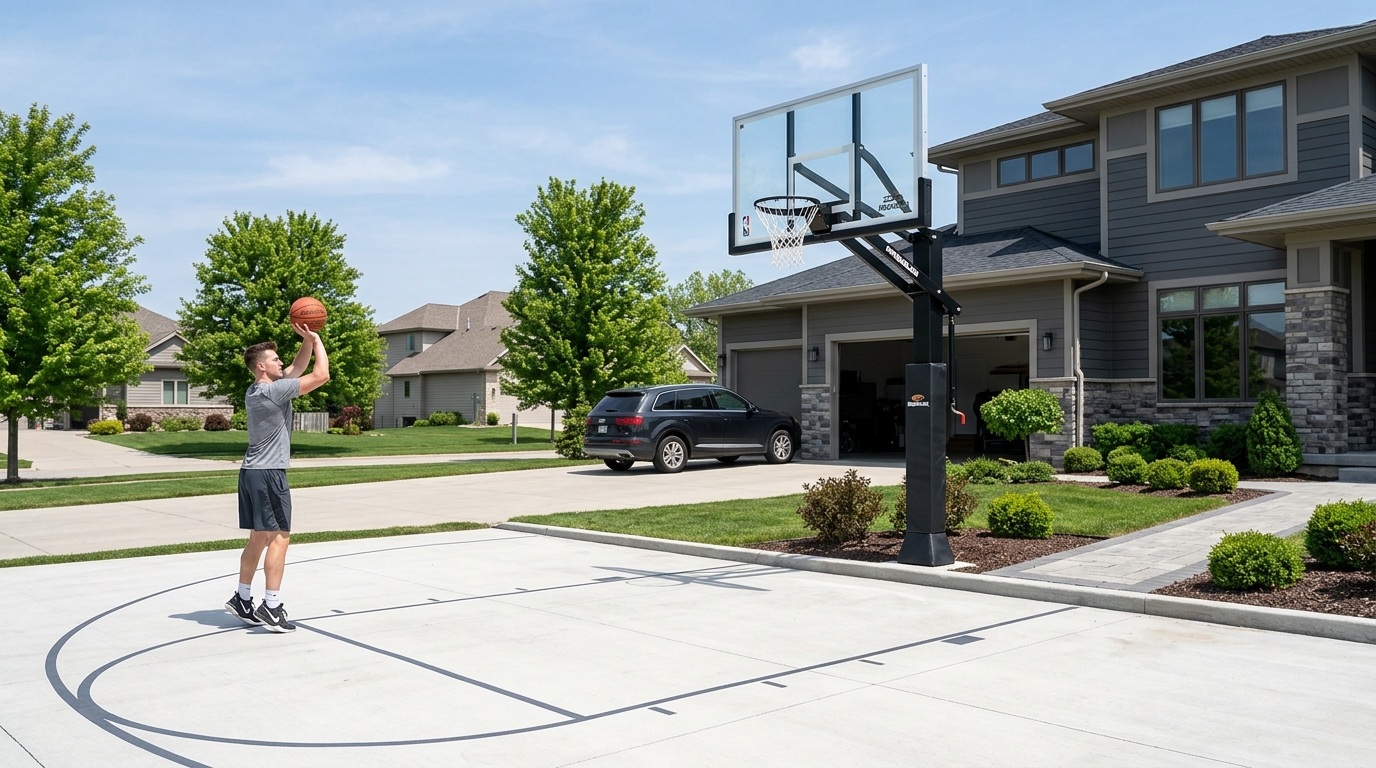
An in-ground basketball hoop is the ultimate driveway upgrade for a basketball-loving household. Unlike portable systems that wobble after every shot and use hollow plastic bases filled with water or sand, a dedicated in-ground system anchored in a solid concrete footing provides a gym-quality, professional experience.
If you are looking to purchase the best in-ground basketball hoop, your primary focus should be on base stability, backboard material longevity under UV exposure, pole design, and the lift mechanism.
In this guide, we review the top-rated in-ground systems on the market, explain the critical engineering details you need to know before digging, and help you choose the right hoop for your driveway court.
The In-Ground Cluster: Where This Fits
To make the best decision for your driveway, it helps to understand where in-ground systems fit relative to other configurations:
- If you are still deciding between permanent installation and mobility, check out our comprehensive In-Ground vs Portable vs Adjustable Basketball Hoops comparison to weigh the installation costs against convenience.
- For driveways that require a mobile solution (due to HOA rules or lease terms), read our review of the best portable basketball hoop for driveway.
- If you want a general look at systems that grow with your kids, browse our best adjustable basketball hoop guide or check out our detailed round-up of the best adjustable basketball hoops for driveway.
- Unsure about how backboard sizing affects play? Read our 50 vs 54 inch basketball backboard guide to choose the perfect size for your driveway playing area.
Best In-Ground Basketball Hoops: Quick Comparison
| Hoop Model | Backboard Size & Material | Pole Construction | Lift Mechanism | Best For |
|---|---|---|---|---|
| Goalrilla FT54 | 54” Tempered Glass | 5” x 5” One-Piece Steel | Actuator Crank | Editor’s Choice / Premium |
| Pro Dunk Gold | 60” Tempered Glass | 6” x 6” One-Piece Steel | Actuator Crank | Serious Competitors |
| Silverback SB54 | 54” Tempered Glass | 4” x 4” Two-Piece Steel | Actuator Crank | Best Mid-Range Value |
| Spalding Gold In-Ground | 54” Acrylic | 4” Round Three-Piece Steel | U-Turn Lift | Best Acrylic Option |
| Lifetime 71525 | 54” Polycarbonate | 3.5” Round Three-Piece Steel | Action Grip Lift | Budget Driveway Setup |
1. Goalrilla FT54 — Editor’s Choice
The Goalrilla FT54 represents the gold standard for driveway in-ground hoops. It features a 54-inch tempered glass backboard and a solid 5” x 5” one-piece steel pole. It uses Goalrilla’s signature three-point technology, which mounts the extension arms directly to the main pole structure to eliminate the typical shaking caused by rim vibration.
 Editor's Choice
 Goalrilla
Goalrilla FT54 In-Ground Basketball Hoop
Gym-quality tempered glass rebound and an extremely stable, heavy-duty anchor bolt system.
Pros
- + 5/16-inch thick tempered glass backboard provides identical rebound performance to indoor gym hoops
- + One-piece, 11-gauge steel pole minimizes flex and wobble better than multi-piece poles
- + Concrete anchor bolt system allows the hoop to be unbolted and moved to a new home if you relocate
- + Smooth actuator crank adjustments from 7.5 to 10 feet
Cons
- − Premium pricing represents a significant upfront investment
- − Concrete installation requires several days of curing and significant physical labor
Goalrilla FT54
Our Verdict
For the absolute best home playing experience, the Goalrilla FT54 is hard to beat. Its combination of a one-piece square steel pole, tempered glass backboard, and bolt-down anchor system delivers the ultimate in durability and ball response. It is a premium product built to last for decades.
SGR Editors
2. Pro Dunk Gold — Best Serious Competitor Hoop
If you are raising a high school player or want a system that can withstand aggressive, competitive daily play, the Pro Dunk Gold is a powerhouse. Featuring a 60-inch tempered glass backboard and a massive 6” x 6” one-piece steel pole, this system is overbuilt in all the right ways. The steel is thicker than average (7-gauge), making it virtually immune to post-dunk sway.
 Heavy Duty
 Pro Dunk
Pro Dunk Gold In-Ground Hoop
Massive 6x6-inch steel pole and 60-inch tempered glass board designed for aggressive play.
Pros
- + Extra-thick 7-gauge steel pole is one of the heaviest and stiffest in the residential class
- + 60-inch tempered glass backboard provides a huge bank-shot target area
- + Dual-spring breakaway rim easily handles aggressive dunking and hanging
- + Heavy-duty crank adjustment mechanism is protected by a lockable cover
Cons
- − Very heavy system (400+ lbs shipped) that requires at least three adults to lift and assemble
- − Premium price point
Pro Dunk Gold
Our Verdict
The Pro Dunk Gold is the closest you can get to an institutional gym hoop on a residential driveway. If you have the space and budget for a 60-inch backboard, its unmatched pole thickness and breakaway rim make it the best option for competitive, aggressive play.
SGR Editors
3. Silverback SB54 — Best Mid-Range Value
Silverback is Goalrilla’s sister brand, designed to offer high-quality in-ground performance at a more accessible price point. The SB54 features a 54-inch tempered glass backboard and a 4” x 4” steel pole. To keep costs down, the pole is a two-piece design rather than a single piece, but it still utilizes a concrete anchor bolt system for excellent stability and portability.
 Best Value
 Silverback
Silverback SB54 In-Ground Hoop
Offers a tempered glass backboard and anchor bolt system at a highly competitive mid-range price.
Pros
- + Tempered glass backboard provides far superior rebound compared to acrylic or polycarbonate alternatives
- + Includes an anchor kit and pole pad, adding extra value right out of the box
- + Smooth crank adjustment system easily adjusts from 7.5 to 10 feet
- + More budget-friendly than Goalrilla or Pro Dunk systems
Cons
- − Two-piece pole design has slightly more vibration and sway than one-piece poles
- − A 4x4-inch pole is less rigid than 5x5 or 6x6-inch configurations under heavy play
Silverback SB54
Our Verdict
The Silverback SB54 is the smart choice for families who want the premium feel of a tempered glass board without paying top-tier prices. While the two-piece pole has slightly more vibration than a one-piece pole, it is still exceptionally stable compared to any portable hoop.
SGR Editors
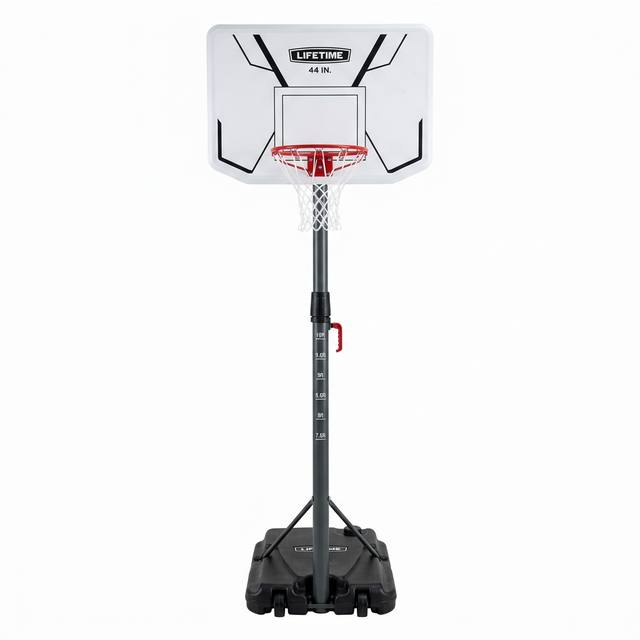
4. Spalding Gold In-Ground — Best Acrylic Option
For driveways located in areas prone to stray balls, golf course perimeters, or high winds where glass might pose a concern, the Spalding Gold In-Ground is a great alternative. It features a 54-inch acrylic backboard. Acrylic is a dense plastic that looks like glass but is much lighter and highly shatter-resistant.
 Best Acrylic
 Spalding
Spalding Gold In-Ground Basketball Hoop
Shatter-resistant acrylic backboard is lighter and highly durable against hard impacts.
Pros
- + Acrylic material is highly shatterproof and survives stray objects or minor accidents
- + U-Turn lift system provides smooth height adjustments
- + Lighter weight makes installation slightly easier than glass models
- + Classic steel breakaway rim absorbs shooting forces
Cons
- − Acrylic backboard provides a softer, slightly deadened rebound response compared to tempered glass
- − 3-piece round pole has more flex and joint vibration than square, one-piece steel poles
- − Acrylic is prone to scratching and can slowly yellow under intense UV sun exposure
Spalding Gold In-Ground
Our Verdict
If safety and impact resistance are your top priorities, the Spalding Gold's acrylic backboard is an excellent option. It performs well and handles driveway abuse, though players looking for gym-like rebound quality should stick to tempered glass.
SGR Editors
5. Lifetime 71525 — Best Budget Driveway Setup
If you want a permanent in-ground hoop but have a tight budget, the Lifetime 71525 is a popular entry-level choice. It features a 54-inch polycarbonate backboard and a 3.5-inch round steel pole. Instead of utilizing a bolt-down anchor system, the bottom pole of this system is buried directly into the concrete hole.
Budget Pick Lifetime
Lifetime 71525 In-Ground Basketball Hoop
Affordable price point makes permanent in-ground installation accessible for most families.
Pros
- + Polycarbonate backboard is virtually indestructible and handles aggressive play and weather
- + Very affordable price compared to glass and one-piece steel systems
- + Action Grip lift mechanism makes height adjustments easy with one hand
Cons
- − Direct burial pole means you cannot easily move the hoop if you sell your house
- − Polycarbonate has a softer, less responsive bounce than glass or acrylic
- − 3.5-inch round pole will experience noticeable sway and vibration when shots hit the rim
Lifetime 71525
Our Verdict
The Lifetime 71525 is a solid, budget-friendly entry into in-ground hoops. It is durable and fun for younger players, but serious shooters will find the pole vibration and soft polycarbonate rebound limiting for high-level practice.
SGR Editors
What to Look for in a Driveway In-Ground Basketball Hoop
When comparing the best in-ground basketball hoops, it is easy to get lost in specifications. Focus on these four core areas to ensure you get a system that matches your playing needs and driveway space.
1. Backboard Material: Glass vs. Acrylic vs. Polycarbonate
The material of your backboard dictates both the rebound quality and how the hoop ages over time:
- Tempered Glass: This is the material used in high school, college, and professional gyms. It is extremely rigid, providing a crisp, realistic bounce. Because glass is heavy, it requires a thicker pole system. In terms of longevity, tempered glass is completely UV-stable—it will never cloud, scratch, or yellow.
- Acrylic: A thick, transparent plastic. Acrylic backboards look like glass and are highly shatterproof, but they are lighter and have a softer rebound. Over time, acrylic will scratch from dirty basketballs and can develop a hazy yellow tint if exposed to intense sunlight.
- Polycarbonate: An engineered plastic that is virtually indestructible. Polycarbonate hoops are ideal for high-wind areas or locations where vandalism is a risk. However, polycarbonate has a very soft, “dead” rebound response and degrades under solar UV radiation faster than acrylic or glass.
2. Pole Construction and Thickness
The pole is the backbone of your hoop. Its design determines how much the hoop shakes after a shot:
- One-Piece Poles: The sturdiest design. A single, continuous piece of square steel (such as on the Goalrilla FT54) has no joints or seam connections to loosen over time. This keeps vibration to a minimum.
- Two-Piece or Three-Piece Poles: These systems slide together during assembly. While easier to ship, the joints create natural points of flex. Even when tightened securely, multi-piece poles will always exhibit more sway than one-piece systems.
- Pole Shape and Width: Square poles are much stiffer than round poles. A 5” x 5” or 6” x 6” square pole offers excellent rigidity, while budget-friendly systems typically use 3.5” or 4” round poles that flex under impact.
3. Installation: Anchor Kits vs. Direct Burial
How the pole connects to the ground affects both installation difficulty and long-term flexibility:
- Anchor Bolt Systems: Premium hoops use an anchor plate embedded in the concrete footing with J-bolts. The hoop pole then bolts onto this plate. This has a huge advantage: if you move, you can simply unbolt the hoop, buy a new anchor kit, and install it at your new house. It also makes leveling the hoop much easier during setup.
- Direct Burial: The lowest pole section is placed directly into the dug hole, and concrete is poured around it. Once the concrete cures, the hoop is permanent. If you move, the hoop stays behind.
4. Overhang and Driveway Safety
Overhang is the distance from the front of the steel support pole to the front of the backboard. This measurement is crucial for safe play:
- Under 2 Feet: Common on budget hoops. This keeps the hoop compact but means players can easily crash into the metal pole during layups or closeout drills.
- 2.5 to 3 Feet: The sweet spot for residential driveways. It gives players enough room to drive and finish under the rim safely while keeping the concrete footing close to the edge of the driveway.
- 4 Feet or More: Regulation gym overhang. This is ideal if you have a dedicated backyard court, but it requires a very thick, heavy pole (6” x 6” minimum) to support the weight at that distance.
Step-by-Step In-Ground Hoop Installation Guide
Installing an in-ground hoop is a multi-step project that requires careful planning. Here is a breakdown of the standard process.
Installation Timeline at a Glance
Step 1: Check HOA Rules & Call 811
Verify local regulations and have utility lines marked before digging.
Step 2: Dig the Hole (4ft Deep)
Excavate a stable footing (usually 48” deep by 16-24” wide).
Step 3: Pour Concrete & Embed J-Bolts
Fill the footing and install the anchor plate J-bolts perfectly level.
Step 4: Cure Concrete (72+ Hours)
Allow the concrete to fully cure before mounting the heavy steel pole.
Step 5: Bolt Pole & Assemble Backboard
Attach the main pole to the anchor and mount the backboard and extension arms.
Step 6: Level Hoop & Attach Rim
Fine-tune the leveling nuts, mount the rim and net, and check height accuracy.
Step 1: Pre-Installation Checks
- HOA Guidelines: Verify that your homeowners association allows in-ground hoops and check if there are setbacks or location restrictions.
- Call 811: Before you dig, you must call 811 (the national dig utility helpline) to have underground gas, water, electric, and sewer lines marked. Never skip this step.
Step 2: Digging the Hole
- Dig a hole based on your manufacturer’s instructions. A standard premium hoop requires a hole roughly 48 inches deep and 16 to 24 inches wide.
- Ensure the walls of the hole are straight or slightly wider at the bottom than the top to prevent the concrete pier from shifting in freezing soil.
Step 3: Pouring Concrete
- Mix and pour wet concrete into the hole. A standard 4-foot footing requires roughly 8 to 14 bags (80 lbs each) of concrete.
- Insert the J-bolts (attached to the anchor plate template) into the wet concrete, ensuring the plate is level and aligned square with your driveway edge.
- Let the concrete cure for a minimum of 72 hours before mounting the pole. Mounting heavy steel too early will crack the green concrete and ruin the foundation.
FAQ
Is tempered glass safe for an outdoor driveway hoop?
Yes. Tempered glass used in outdoor basketball hoops is highly impact-resistant and designed to break into small, harmless pebbles if shattered, similar to car windows. It is extremely durable against basketball impacts, though you should avoid placing it where landscaping tools (like lawnmowers) could kick up stones against the glass.
How do you level an in-ground hoop after the concrete is dry?
Anchor bolt systems use leveling nuts underneath the pole's base plate. By adjusting these nuts with a large wrench, you can level the pole in all directions even if your poured concrete foundation is slightly uneven. Direct burial hoops must be held perfectly level while the concrete is being poured and cured.
How long does a tempered glass in-ground hoop last?
A premium in-ground system from a reputable brand like Goalrilla or Pro Dunk can easily last 15 to 20+ years. The tempered glass board will not degrade under UV exposure, and the powder-coated steel pole resists rust. You will likely only need to replace the net every few seasons.
What concrete mix should I use for a basketball hoop foundation?
Use a standard high-strength concrete mix (such as Quikrete 5000 or a similar 4000+ PSI mix) for the footing. This ensures the foundation is strong enough to absorb the constant leverage and vibration of a 300+ lb hoop system.
Sources & Additional Resources
- Goalrilla In-Ground Hoop Anchoring Systems
- Pro Dunk Hoops Owner Manuals & Guidelines
- Call 811 Official Site - Safe Digging Information
- Check out our detailed analysis on 50 vs 54 Inch Basketball Backboards to determine if a compact board fits your space.
- Compare permanent setups against transportable ones in our Best Portable Basketball Hoops for Driveways review.
How we evaluate: We combine manufacturer documentation, independent user feedback, and parent-focused criteria like safety, durability, ease of use, and long-term value.
Accuracy note: Pricing and product availability can change. Verify details on the retailer site before purchase.
Affiliate Disclosure: Sports Gadget Review is a participant in the Amazon Services LLC Associates Program. When you purchase through links on this page, we may earn a commission at no extra cost to you. Editorial recommendations are made independently.