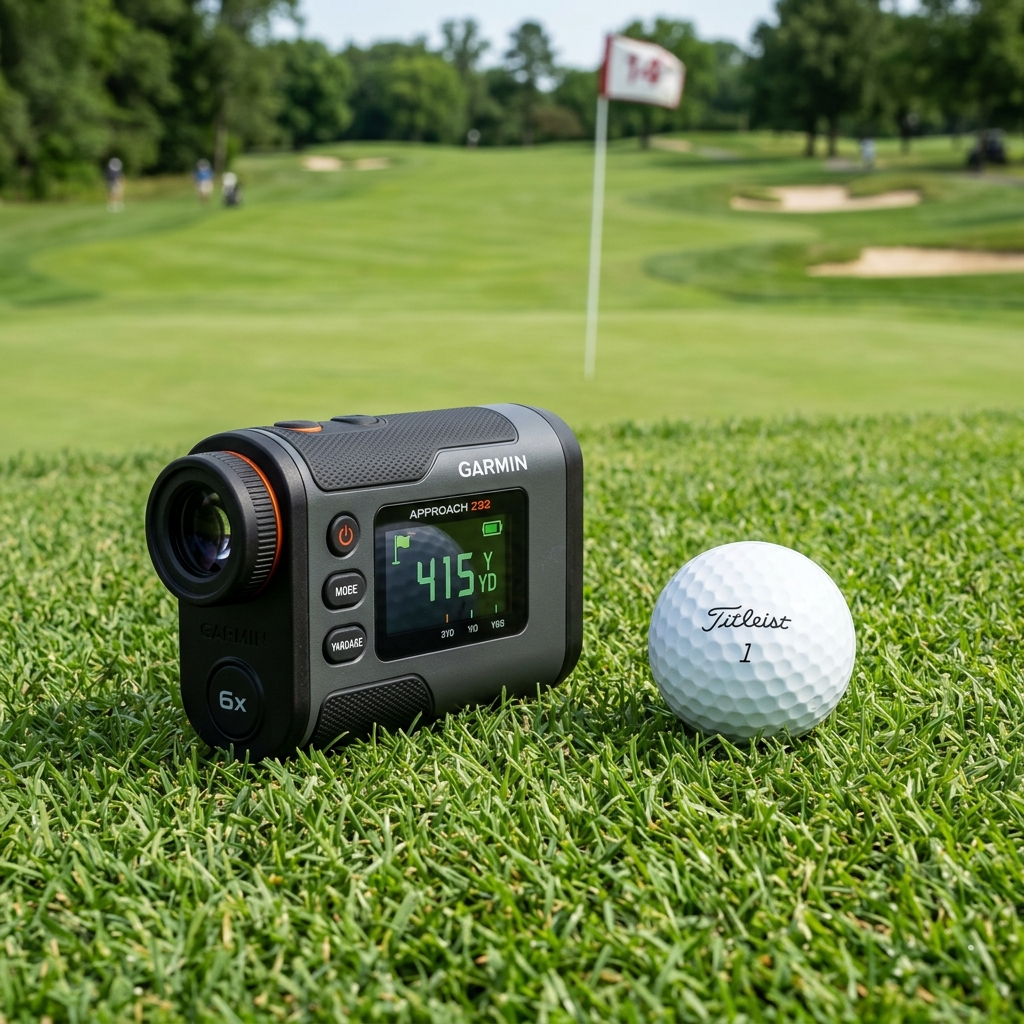
A $500 rangefinder and a $150 rangefinder both shoot a laser at the flag and tell you the distance. The physics are identical. The differences come down to optics quality, acquisition speed, stabilization, and whether slope compensation is included. After testing six rangefinders priced between $89 and $199, the performance gap between budget and premium has narrowed dramatically — several sub-$200 models now deliver ±1 yard accuracy and slope-adjusted distances that rival units costing three times as much.
Here’s what actually matters at this price point, and which rangefinders earn your money.
Quick Comparison: All 6 Rangefinders Tested
| Rangefinder | Price | Slope | Magnification | Range | Accuracy | Weight |
|---|---|---|---|---|---|---|
| Precision Pro NX10 | $199 | Yes (toggle) | 6x | 400 yds | ±0.5 yd | 6.4 oz |
| Gogogo Sport Vpro GS24 | $89 | Yes | 6x | 650 yds | ±1 yd | 6.5 oz |
| TecTecTec VPRO500S | $149 | Yes (toggle) | 6x | 540 yds | ±1 yd | 6.2 oz |
| Callaway 300 Pro Slope | $179 | Yes (toggle) | 6x | 1,000 yds | ±1 yd | 8.8 oz |
| Blue Tees Series 3 Max | $199 | Yes (toggle) | 7x | 900 yds | ±0.5 yd | 6.8 oz |
| Caddytek CaddyView V3 | $119 | No | 6x | 800 yds | ±1 yd | 5.9 oz |
Top 3 Picks
1. Precision Pro NX10 — Best Overall Under $200
 Best Overall
 Precision Pro
Precision Pro NX10 Slope Golf Rangefinder
Tournament-legal slope toggle with magnetic cart mount included
The NX10 is the rangefinder that made me stop recommending the Bushnell Tour V5 to casual golfers. At $199, it delivers ±0.5 yard accuracy — the same spec Bushnell advertises on their $299 models — and includes a physical slope toggle switch that makes it tournament-legal in seconds.
The optics punch above their price. The 6x magnification lens is clear edge-to-edge with minimal chromatic aberration, even in low-light conditions during early morning rounds. The target acquisition vibration (Precision Pro calls it “Pulse Vibration”) locks onto the flag within 0.3 seconds on most shots, though it occasionally hunts on pins backed by trees beyond 200 yards.
Slope compensation is the headline feature. The NX10 calculates adjusted distances based on elevation change — a 150-yard shot playing uphill to an elevated green might read 157 yards with slope enabled. Toggle the external switch to disable slope for tournament play, and the unit displays “SLOPE OFF” in the viewfinder so you have visual confirmation.
The magnetic cart mount is a genuine value-add. The built-in magnet snaps to any cart bar or metal surface. No case fumbling between shots. This alone saves 10-15 seconds per hole if you ride.
Precision Pro backs the NX10 with free battery replacements for life — they’ll mail you a new CR2 battery whenever you need one. It’s a small thing, but no competitor offers this.
What it lacks: No image stabilization. Your hand shake is visible at 250+ yards, which can make acquiring distant pins slightly frustrating on windy days.
2. Blue Tees Series 3 Max — Best Optics Under $200
 Best Optics
 Blue Tees
Blue Tees Series 3 Max Golf Rangefinder
7x magnification with premium HD lens clarity
Blue Tees positioned the Series 3 Max as their flagship budget model, and the optics justify it. The 7x magnification is the highest in this roundup — the extra zoom makes a noticeable difference when targeting pins at 200+ yards. The HD lens coating produces a brighter, sharper image than any other sub-$200 rangefinder I’ve used.
Accuracy matches the Precision Pro at ±0.5 yards. The slope toggle sits on the side of the unit, flush-mounted and easy to switch without looking. The OLED display inside the viewfinder is crisp with adjustable brightness — a feature typically reserved for $300+ models.
The Series 3 Max locks onto targets quickly with its flag-lock jolt vibration. I consistently acquired the pin on the first press from 180 yards in, and within two presses from 180-250 yards. Beyond 250, tree backgrounds occasionally cause the laser to read the tree instead of the flag — a common issue at this price point.
At 6.8 oz, it’s slightly heavier than the Precision Pro NX10 (6.4 oz), but the difference is imperceptible in a pocket. The included carrying case is decent quality — reinforced stitching, carabiner clip, and a magnetic closure.
What it lacks: No magnetic cart mount included (sold separately for $15). The battery compartment requires a small screwdriver, which is mildly annoying during battery changes.
3. Gogogo Sport Vpro GS24 — Best Budget Pick
 Best Value
 Gogogo Sport
Gogogo Sport Vpro GS24 Golf Rangefinder
Slope-compensated accuracy at an unbeatable $89 price point
The GS24 has over 12,000 Amazon reviews and a 4.4-star rating for a reason — it delivers legitimate rangefinder performance at a price point that used to buy a sleeve of Pro V1s and lunch.
At $89, slope compensation is included. That’s remarkable. The accuracy is ±1 yard, which is a half-yard less precise than the top two picks but functionally irrelevant on the golf course. Nobody clubs to the half-yard.
The 6x magnification optics are acceptable — not as bright or sharp as the Blue Tees Series 3 Max, but clear enough to identify a flag at 250 yards. The flag-lock vibration works, though the acquisition speed is noticeably slower than the premium picks. Budget golfers will need an extra second or two per scan, especially beyond 200 yards.
The biggest limitation is the slope toggle. The GS24 uses a mode button to switch between slope and non-slope readings rather than a dedicated external switch. This means you can’t visually confirm slope is disabled from the outside — tournament officials may question it. For casual rounds and non-tournament play, this is irrelevant. For USGA-sanctioned events, the Precision Pro NX10 or TecTecTec VPRO500S with their external toggles are safer choices.
Build quality feels like $89. The plastic housing is functional but not premium. The carrying case is thin nylon. None of this affects performance, but the NX10 and Blue Tees feel more substantial in hand.
Perfect for: Beginners, casual golfers, anyone who loses rangefinders, and golfers who want slope data without spending $200.
The Other Three: Quick Takes
4. TecTecTec VPRO500S — $149
The VPRO500S was the budget rangefinder king for years, and it’s still a solid mid-range pick. The external slope toggle is clean, the accuracy is ±1 yard, and the brand has an established repair and warranty network. It’s lost ground to the Precision Pro NX10 (better accuracy, same price) and the Gogogo GS24 (similar performance, $60 less). If you find it on sale under $120, it’s a strong buy.
5. Callaway 300 Pro Slope — $179
The name brand carries weight, and the Callaway 300 Pro delivers respectable performance. 1,000-yard max range (mostly marketing — you’ll never range a flag at 1,000 yards), ±1 yard accuracy, and a pin-acquisition mode that works well within 200 yards. The main drawback is weight — at 8.8 oz, it’s noticeably heavier than every other model tested. The slope toggle is well-designed and tournament-compliant.
6. Caddytek CaddyView V3 — $119 (No Slope)
The only non-slope model in this roundup, and it earns its spot purely on optics and accuracy. If you play courses with minimal elevation change or your club prohibits slope devices entirely, the CaddyView V3 offers ±1 yard accuracy, crisp 6x optics, and the lightest weight in the group (5.9 oz). At $119 without slope, it’s a tougher sell compared to the Gogogo GS24 at $89 with slope — but the optics quality is notably better.
Slope vs. No-Slope: Do You Need It?
Slope compensation measures the elevation difference between you and the target, then adjusts the distance to reflect how the ball will actually play. A 150-yard shot to a pin 30 feet above you plays like 157-160 yards. Without slope, you’re guessing.
The practical value depends on your courses:
- Flat courses (Florida, links-style): Slope adds almost nothing. Elevation changes are minimal, and the adjusted distance rarely differs by more than 1-2 yards from the actual distance.
- Hilly courses (Appalachian, Pacific Northwest, mountain courses): Slope is genuinely useful. Elevation swings of 50-100 feet per hole are common, and the adjusted distance can differ by 10-15 yards from the laser reading.
- Tournament play: USGA Rule 14.3 prohibits slope compensation during competition. Your rangefinder must have a physical, externally verifiable slope toggle to be tournament-legal. Software-only toggles (like the Gogogo GS24’s mode button) may not satisfy officials.
At this price point, slope adds roughly $20-40 to the cost. Given that five of six models in this roundup include slope, the feature has essentially become standard in the sub-$200 category.
What Accuracy Specs Actually Mean
Every rangefinder advertises accuracy in ±yards. Here’s what to understand:
±0.5 yard accuracy (Precision Pro NX10, Blue Tees S3 Max): Means a 150-yard target reads between 149.5 and 150.5 yards. In practice, this is more precise than your ability to execute the shot. Useful for golfers who carry distance gaps between clubs of 8-10 yards.
±1 yard accuracy (Gogogo GS24, TecTecTec, Callaway, Caddytek): Means a 150-yard target reads between 149 and 151 yards. Still more precise than human execution. The difference between ±0.5 and ±1 is undetectable on the course for 95% of golfers.
Where accuracy degrades: All rangefinders lose accuracy beyond their effective range. The marketed “max range” (650-1,000 yards) refers to reflective targets. On a non-reflective flag, expect reliable readings to 300-400 yards maximum, with accuracy degrading beyond 250 yards on most sub-$200 units.
Magnification and Optics Quality
Magnification ranges from 6x to 7x in this roundup. The practical impact:
- 6x magnification (most models): Adequate for targeting pins at 100-250 yards. Beyond 250, the pin appears small enough that precise aiming requires steady hands.
- 7x magnification (Blue Tees S3 Max): The extra zoom makes a visible difference at 200+ yards. The pin appears ~17% larger, which translates to faster acquisition and less hand-shake frustration.
Optics quality — lens coatings, light transmission, edge clarity — varies more than magnification numbers suggest. The Blue Tees and Precision Pro NX10 use multi-coated lenses that produce brighter, more color-accurate images than the Gogogo GS24’s simpler lens stack. In bright sunlight, the difference is minimal. During dawn rounds, overcast days, or late-afternoon play, the premium optics deliver noticeably better visibility.
If you’re also looking to tech up other parts of your game, our best golf launch monitors for home practice guide covers affordable swing data tools. For launch monitors specifically under $500, see our dedicated budget launch monitor roundup.
How to Choose: Decision Matrix
Buy the Precision Pro NX10 if: You want the best overall package — accuracy, slope toggle, magnetic mount, and lifetime battery replacement. It’s the rangefinder I’d recommend to any golfer who doesn’t want to overthink the decision.
Buy the Blue Tees Series 3 Max if: Optics quality is your priority. The 7x magnification and HD lens are the best in class at this price. Great for golfers with less-than-perfect eyesight or those who play courses with distant, hard-to-see pins.
Buy the Gogogo GS24 if: You want slope data for under $100 and don’t care about premium build quality. It’s the best rangefinder for beginners who aren’t sure they’ll stick with the sport.
Buy the Caddytek CaddyView V3 if: You specifically need a no-slope unit for tournament compliance and want clean optics at a fair price.
For other gadgets to upgrade your golf setup, check out our guide on sports cameras and GoPro alternatives for recording your swing on the course. And if you’re building a youth athlete’s tech kit on a budget, our youth sports tech budget guide covers the essentials across multiple sports.
Frequently Asked Questions
Are cheap golf rangefinders accurate enough to improve my game?
Yes. Every rangefinder in this roundup delivers ±1 yard accuracy or better within 250 yards — that’s more precise than the average golfer’s shot dispersion. A 15-handicap golfer has a distance scatter of ±10-15 yards with a 7-iron. The rangefinder’s ±1 yard accuracy is a rounding error compared to swing variance. The real value is eliminating guesswork — knowing it’s 163 yards instead of “somewhere around 160” lets you commit to a club and swing with confidence.
Can I use a rangefinder with slope in a tournament?
Only if the rangefinder has a slope-disable feature that’s externally verifiable. USGA Rule 14.3b permits distance-measuring devices but prohibits slope compensation during competition. Models with an external physical toggle switch (Precision Pro NX10, TecTecTec VPRO500S, Callaway 300 Pro, Blue Tees S3 Max) are tournament-legal when slope is disabled. Models that use a software button (Gogogo GS24) may face scrutiny from rules officials since there’s no external way to verify slope is off.
How long do rangefinder batteries last?
Most golf rangefinders use a single CR2 lithium battery. Expect 6-12 months of regular use (2-3 rounds per week) from one battery. The Precision Pro NX10 offers free lifetime battery replacements — request a new one through their website whenever yours dies. CR2 batteries cost $3-5 at any hardware store or pharmacy if you need one immediately.
What’s the difference between a $150 rangefinder and a $400 Bushnell?
Three things: stabilization, glass quality, and acquisition speed. Premium Bushnell models (Tour V5, Pro X3) include image stabilization that eliminates hand shake — particularly valuable for ranging beyond 250 yards. Their ED Prime glass delivers sharper, brighter images with less color fringing. And their JOLT technology locks onto the flag slightly faster (0.1-0.2 seconds) than budget models. Are those differences worth $200-250 extra? For competitive golfers who range multiple targets per hole and play in variable conditions, probably. For weekend players hitting 85-100, absolutely not.
Should I buy a rangefinder or a GPS watch for golf?
Different tools for different purposes. A rangefinder gives precise distance to any target you point at — the flag, a bunker, the front edge, a layup point. A GPS watch gives pre-mapped distances to the front, middle, and back of each green without any aiming required. Most serious golfers carry both: the GPS watch for quick reference and general course management, the rangefinder for precise pin distances on approach shots. If you’re picking one, a rangefinder delivers more actionable data per shot. For multi-sport athletes who want a GPS watch that also covers golf, see our best triathlon smartwatch guide.
Updated June 2026
How we evaluate: We combine hands-on use (when available), manufacturer documentation, independent user feedback, and parent-focused criteria like safety, durability, ease of use, and long-term value.
Accuracy note: Pricing and product availability can change. Verify details on the retailer site before purchase.
Affiliate Disclosure: Sports Gadget Review is a participant in the Amazon Services LLC Associates Program. When you purchase through links on this page, we may earn a commission at no extra cost to you. Editorial recommendations are made independently.