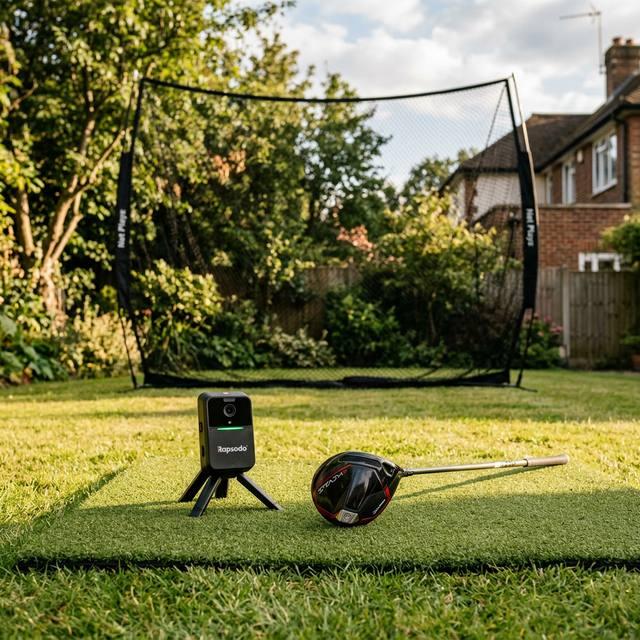
The best golf launch monitor under $500 is the one that gives you useful carry distances, speed numbers, and practice feedback without pretending to be a tour-level fitting system. For most golfers, that means choosing between Garmin Approach R10 for the deepest data set, Rapsodo MLM2PRO for video and simulator use, FlightScope Mevo for portable radar practice, or a simpler Swing Caddie/PRGR unit when you mainly want distance and speed.
If you are building a garage or backyard setup, also read our home golf launch monitor guide. This page is the focused budget buying guide; the home guide covers room size, nets, mats, and simulator workflow.
Quick Picks
| Buyer need | Best fit | Why |
|---|---|---|
| Most complete budget data | Garmin Approach R10 | Broad metric set, strong app, indoor and outdoor use |
| Video plus simulator practice | Rapsodo MLM2PRO | Dual camera and radar, swing replay, simulator ecosystem |
| Portable radar practice | FlightScope Mevo | Compact unit, FlightScope app support, good range-session fit |
| Built-in display simplicity | Swing Caddie SC4 or SC300i | No phone needed for basic range feedback |
| Cheapest useful speed feedback | PRGR portable monitor | Simple speed and estimated distance numbers |
What Budget Launch Monitors Can and Cannot Do
Budget launch monitors are useful for practice trends: carry distance, ball speed, club speed, launch angle, smash factor, and session averages. They are not a replacement for a professional fitting bay when spin axis, exact wedge spin, and driver optimization matter.
That distinction is important. A budget unit can tell you whether your 7-iron usually carries around the same window and whether a swing change is adding ball speed. It should not be the only tool you use to order custom shafts or fine-tune driver spin.
1. Garmin Approach R10 - Best Overall Budget Pick
Garmin’s Approach R10 is still the safest starting point for golfers who want the most complete data set in a small package. Garmin describes the R10 as a portable launch monitor with more than a dozen golf metrics and virtual rounds through the Garmin Golf ecosystem.
Check current Garmin Approach R10 price on Amazon
Why it works: The R10 is compact, battery-friendly, and useful indoors or outdoors when you give it enough ball flight. Garmin’s own manual lists up to 10 hours of battery life, which is enough for multiple range sessions before charging.
Tradeoffs: Radar spin and club-path numbers at this price should be treated as practice feedback, not professional fitting truth. Indoor use also depends heavily on alignment, mat quality, and enough space behind and in front of the ball.
Best for: Golfers who want one budget monitor for range work, net practice, and occasional simulator rounds.
2. Rapsodo MLM2PRO - Best for Video and Simulator Use
The Rapsodo MLM2PRO is the best fit when you care about swing video, shot replay, and simulator features as much as raw numbers. Rapsodo lists dual optical camera vision plus radar processing, 15 metrics, and simulator/course features tied to its premium ecosystem.
Check current Rapsodo MLM2PRO price on Amazon
Why it works: Video context helps you connect launch data to swing changes. If you are working remotely with a coach, clips and shot traces are easier to discuss than numbers alone.
Tradeoffs: Rapsodo’s best simulator and advanced features can depend on its premium membership. Check the current included trial and subscription terms before buying, because those details affect long-term cost.
Best for: Garage-simulator shoppers and golfers who want video feedback with launch data.
3. FlightScope Mevo - Best Compact Radar Option
FlightScope’s Mevo line is the portable radar option for golfers who want a small unit and a simple practice app. FlightScope’s current Mevo Gen2 materials list the FS Golf Practice App, FS Skills Challenges, an E6 Connect course bundle, and included aluminum stickers.
Check current FlightScope Mevo price on Amazon
Why it works: The Mevo approach is strongest when you practice at different locations and want a small unit that travels easily. It is a better fit for trend tracking than for deep simulator play.
Tradeoffs: Indoor spin tracking can require marked balls or stickers, and the smaller data set is less complete than Garmin or Rapsodo for golfers who want club-path style feedback.
Best for: Range-focused golfers who value portability and a clean practice workflow.
4. Swing Caddie SC4 or SC300i - Best Built-In Display Path
Swing Caddie style monitors are appealing because you can place the unit, hit balls, and read numbers without keeping your phone open. The SC4/SC4 Pro generation also moved closer to simulator use, while older SC300i units remain simple range tools.
Check current Swing Caddie launch monitor prices on Amazon
Why it works: Built-in display feedback is underrated at the range. You can focus on carry, ball speed, and smash factor without juggling an app after every shot.
Tradeoffs: Model names and availability can be confusing, and simulator support varies by version. Check the product page carefully before buying.
Best for: Golfers who want quick range feedback and minimal setup.
5. PRGR Portable Monitor - Best Simple Speed Tool
The PRGR is not a full simulator-ready launch monitor. It is a simple speed and distance feedback tool. That can still be enough if your main goal is learning swing speed, ball speed, and basic club gapping.
Check current PRGR portable monitor price on Amazon
Why it works: It keeps the practice loop simple. Hit, read the number, make the next swing. That is useful for speed training and basic distance checks.
Tradeoffs: No spin, no simulator experience, and limited context. Do not buy it expecting a Garmin or Rapsodo replacement.
Best for: Budget-conscious golfers who want speed feedback more than a complete launch-data dashboard.
Indoor vs Outdoor Buying Notes
| Setup | Best budget fit | Watch out for |
|---|---|---|
| Outdoor range | Garmin R10, FlightScope Mevo, Swing Caddie | Range balls can fly shorter than premium balls |
| Garage net | Garmin R10 or Rapsodo MLM2PRO | Space, alignment, mat quality, lighting |
| Simulator screen | Rapsodo MLM2PRO or Garmin R10 | Subscription and third-party software costs |
| Speed training | PRGR or Swing Caddie | Limited shot-shape and spin context |
| Coach video review | Rapsodo MLM2PRO | App workflow and membership terms |
Subscription and Software Check
Before buying, check three things on the current product page:
- Which metrics are included without a subscription.
- Which simulator apps are supported now.
- Whether the included trial or course bundle is temporary.
Garmin and PRGR are usually easier to understand for basic practice. Rapsodo and FlightScope can offer richer simulator workflows, but the long-term value depends on the software you actually plan to use.
Sources
- Garmin Approach R10 product page
- Garmin Approach R10 manual specifications
- Rapsodo MLM2PRO product page
- Rapsodo Premium Membership explainer
- FlightScope Mevo Gen2 product page
What is the best golf launch monitor under $500?
The Garmin Approach R10 is the best starting point for most golfers because it balances data, portability, app support, and indoor/outdoor use. Choose Rapsodo MLM2PRO instead if video replay and simulator features matter most.
Are budget golf launch monitors accurate enough?
They are accurate enough for practice trends, carry-distance gapping, and speed feedback. They are not precise enough to replace a professional fitting system for driver spin, spin axis, or paid club fitting decisions.
Do budget launch monitors work indoors?
Yes, but setup matters. Radar units need enough space and careful alignment. Camera and hybrid systems need good lighting. A quality mat and net also affect the usefulness of the numbers.
Do I need a subscription?
Core metrics are often available without a subscription, but simulator play, course libraries, cloud storage, and advanced analytics may require paid software. Check the current product page before buying.
Should I buy a launch monitor or a rangefinder first?
Buy a rangefinder or GPS first if you only need on-course yardages. Buy a launch monitor when you want to learn how far you actually carry each club and make practice sessions measurable.
How we evaluate: We combine manufacturer documentation, independent user feedback, and parent-focused criteria like safety, durability, ease of use, and long-term value.
Accuracy note: Pricing and product availability can change. Verify details on the retailer site before purchase.
Affiliate Disclosure: Sports Gadget Review is a participant in the Amazon Services LLC Associates Program. When you purchase through links on this page, we may earn a commission at no extra cost to you. Editorial recommendations are made independently.