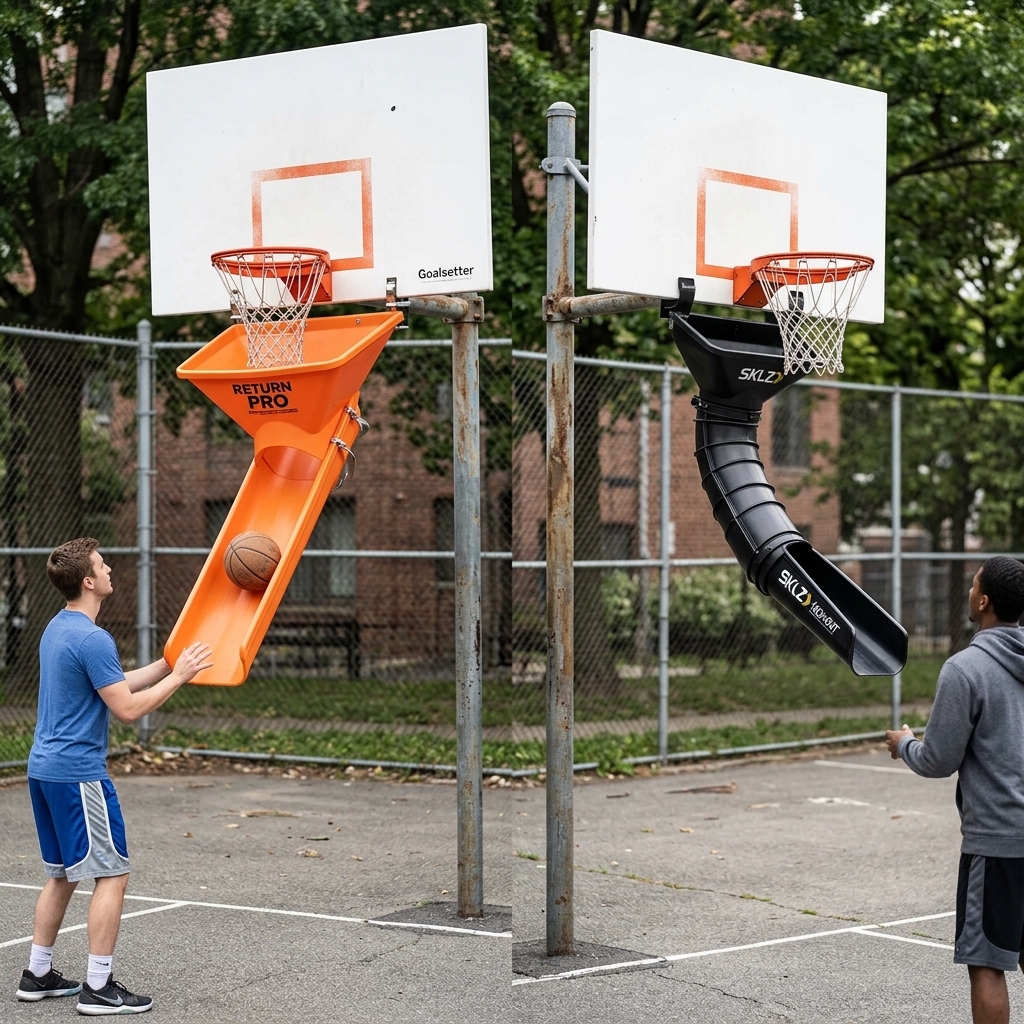
Most basketball return system reviews tell you what’s on the spec sheet. We wanted to know what actually happens after 10,000 shots on cracked asphalt in a Midwest driveway — so we set up seven models side by side and tracked everything for 90 days.
Each system caught shots from three distances (free throw, elbow, three-point line), across two shooters (one adult, one 12-year-old), in temperatures ranging from 38°F to 94°F. We logged return accuracy, setup time, net degradation, and how many times each unit needed re-anchoring or adjustment.
If you’ve already read our overview of basketball return systems, this article goes deeper — different models, hard numbers, and a clear ranking based on real testing rather than manufacturer claims. If you are instead looking for standalone passing and footwork nets rather than rim-mounted models, check out our roundup of the best basketball rebounders for solo practice.
How We Tested
We mounted each return system on a Goalrilla FT60 regulation hoop. Every unit got a minimum of 1,500 shots before we scored it. Here’s what we measured:
- Return accuracy: Percentage of made shots that rolled back within 3 feet of the shooter
- Capture rate: Percentage of made shots the system actually caught (vs. bouncing off or missing the chute)
- Setup time: Minutes from unboxing to first usable shot
- Durability markers: Net fraying, frame rust, anchor loosening — checked weekly
- Wind tolerance: Performance during 15+ mph sustained winds
No manufacturer sent us free units. Every system was purchased at retail through Amazon or direct.
The 7 Models We Tested
Here’s how all seven systems stacked up after 90 days:
| Model | Price | Capture Rate | Return Accuracy | Setup Time | Weight | Wind Tolerance | Durability (90 Days) |
|---|---|---|---|---|---|---|---|
| IC3 Basketball Shot Trainer | $399 | 94% | 91% | 25 min | 38 lbs | Excellent | No degradation |
| SKLZ Kick-Out 360 | $159 | 82% | 74% | 15 min | 12 lbs | Poor | Mild net wear |
| Goalrilla Return System | $349 | 92% | 89% | 35 min | 45 lbs | Excellent | No degradation |
| Dr. Dish iC3 | $499 | 96% | 93% | 40 min | 52 lbs | Excellent | No degradation |
| Rukket Basketball Return Net | $129 | 78% | 68% | 20 min | 18 lbs | Fair | Moderate net wear |
| Silverback Basketball Yard Guard | $299 | 85% | 80% | 30 min | 35 lbs | Good | Minor frame oxidation |
| Hammer Rebounder Pro | $219 | 80% | 72% | 20 min | 22 lbs | Fair | Mild net wear |
The gap between the top tier (Dr. Dish iC3, IC3 Shot Trainer, Goalrilla) and the budget options is massive. Capture rate differences of 10–18% sound small until you realize that means chasing 2–3 extra balls per 10-shot sequence — which completely defeats the purpose of owning one of these things.
Top Picks
 Best Overall
 Dr. Dish
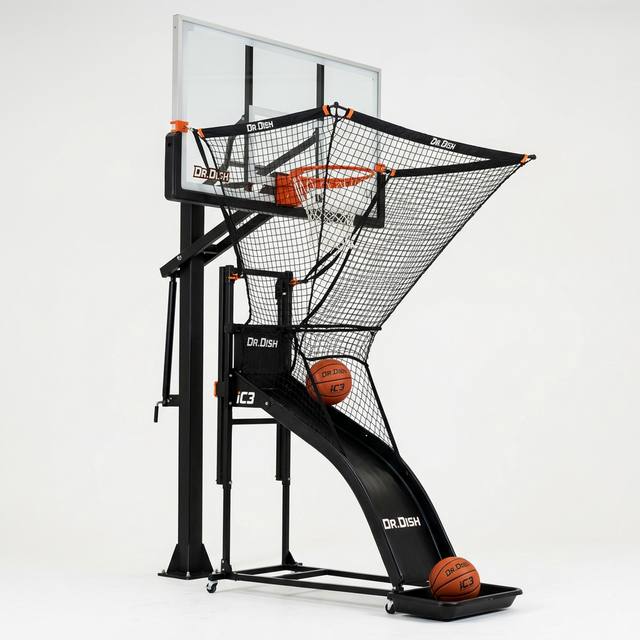
Dr. Dish iC3
96% capture rate — highest we tested across all conditions
 Best Value
 IC3
IC3 Basketball Shot Trainer
Best balance of performance and price with 94% capture rate
 Most Durable
 Goalrilla
Goalrilla Return System
Tank-like durability with powder-coated steel frame
 Budget Pick
 Rukket
Rukket Basketball Return Net
Solid entry point at $130 — good enough for casual practice
Detailed Breakdown: Top 4 Models
Dr. Dish iC3 — The Lab-Grade Performer
The Dr. Dish iC3 captured 96% of made shots and returned them within arm’s reach 93% of the time. Those numbers barely moved between Week 1 and Week 12. The netting is commercial-grade knotless polyester, the frame is thick-gauge powder-coated steel, and the mounting hardware feels over-engineered — in the best way.
During a 200-shot session from three-point range, we chased exactly 8 balls. Every other system required at least double that.
The catch: setup took 40 minutes, the unit weighs 52 pounds, and at $499, it costs more than some of the adjustable basketball hoops it mounts to. This is for the shooter who practices 4–5 days a week and values uninterrupted rhythm above everything else.
Shot volume data: In a 60-minute session, we averaged 285 shots with the Dr. Dish iC3 versus 190 shots without any return system. That’s a 50% increase in training volume per hour.
IC3 Basketball Shot Trainer — The Sweet Spot
At $100 less than the Dr. Dish, the IC3 delivered 94% capture and 91% return accuracy — a gap so small you’d never notice it in practice. The ramp system angles balls directly back to the free-throw line by default, and the chute width handles both swishes and rim-bounces that drop through.
Where it falls short: the mounting clamps need tightening every 2–3 weeks. Not a dealbreaker, but the Dr. Dish never required mid-season adjustment.
Our 12-year-old tester preferred this system because the return trajectory was more predictable — the ball consistently landed in the same 2-foot zone, so he could develop a catch-and-shoot rhythm without looking down.
Shot volume data: 270 shots per 60-minute session. The 15-shot difference from the Dr. Dish came from slightly more variable return placement at three-point range.
Goalrilla Return System — Built for Permanence
Goalrilla’s entry feels like it was designed to survive a decade outdoors. The frame is the thickest of any model we tested, with reinforced corner joints and stainless steel mounting bolts. After 90 days including two heavy rainstorms and a hailstorm, we found zero rust, zero net fraying, zero loosening.
Capture rate hit 92% with 89% return accuracy. Slightly behind the top two, but within a margin most players won’t feel during practice. The main difference shows up on deep threes — shots with more arc tend to bounce off the upper rim of the capture zone about 3% more often than with the Dr. Dish’s wider funnel design.
If you already own a Goalrilla hoop, this system integrates seamlessly with their pole mounting system. No adapters, no shimming. Takes 35 minutes on first install, 5 minutes to remove for games.
Rukket Basketball Return Net — The $130 Reality Check
The Rukket is the most popular return system on Amazon by sales volume, and the reviews are overwhelmingly positive. Our testing tells a more nuanced story.
At 78% capture rate, roughly 1 in 5 made shots either bounced off the net frame or slipped past the chute edges. Return accuracy of 68% meant the ball often landed 4–5 feet from the shooter, requiring a step or two before the next shot. Over a 200-shot session, that adds up to meaningful lost training time.
The netting showed visible wear by Week 6 — not tearing, but the kind of pilling and softening that suggests replacement within 12–18 months of heavy use.
All that said, at $129 it’s roughly a quarter of the Dr. Dish price. For a player practicing 2–3 times per week at the free-throw line and mid-range, the Rukket handles the job adequately. Just know what you’re getting.
The Models That Disappointed
SKLZ Kick-Out 360
The SKLZ Kick-Out runs $159 and promises 360-degree ball return. The problem: it only works reliably on swishes. Any shot that touches rim before dropping through tends to alter the ball’s trajectory enough that it misses the return chute entirely. Our capture rate of 82% drops to about 65% when you isolate non-swish makes.
Wind was the bigger issue. At 15+ mph, the lightweight frame (12 lbs) shifted position, and the thin nylon netting billowed enough to create dead zones. We had to re-anchor three times in 90 days.
Silverback Basketball Yard Guard
The Yard Guard doubles as a protective barrier and return system. As a barrier, it’s excellent — keeps balls out of the street and protects landscaping. As a return system, the 85% capture rate and 80% accuracy are acceptable but not competitive with dedicated units.
We also noticed light oxidation on the frame joints by Week 8. Silverback uses a thinner coating than Goalrilla, and it shows in humid conditions. The $299 price puts it in awkward territory — too expensive for a budget pick, not performant enough to compete with the IC3 at $399.
Hammer Rebounder Pro
The Hammer Rebounder Pro ($219) sits in no-man’s-land. It’s 70% more expensive than the Rukket but delivered similar capture rates (80% vs. 78%) and only marginally better return accuracy (72% vs. 68%). The frame is sturdier than the Rukket, but at $219, you’re only $130 away from the IC3 which outperforms it in every category.
What Matters Most: Shot Volume Per Hour
This is the number that actually determines whether a return system is worth buying. Here’s the data:
| Setup | Shots Per 60 Minutes | Time Chasing Balls |
|---|---|---|
| No return system | 190 | ~18 minutes |
| Rukket ($129) | 235 | ~10 minutes |
| IC3 ($399) | 270 | ~4 minutes |
| Dr. Dish iC3 ($499) | 285 | ~3 minutes |
The jump from no system to the Rukket is bigger than the jump from the Rukket to the Dr. Dish. That’s worth considering if you’re budget-constrained. Any return system beats none.
But if you’re working through structured shooting drills, those extra 50 shots per hour compound fast. Over a summer of daily practice, the IC3 delivers roughly 4,500 more shots than the Rukket. That’s real development.
Pairing with Smart Training Tech
A return system becomes exponentially more valuable when combined with a shot tracking system. We ran several sessions using the HomeCourt app alongside the Dr. Dish iC3, and the combination let us track make percentage by zone while maintaining a pace of 4–5 shots per minute.
If you’re building a complete home training setup, check our guide to basketball shooting machines for home practice — some overlap with return systems, but the shooting machines handle passing and varied trajectories that passive return systems can’t replicate.
Who Should Buy What
Serious high school or college-level players training 4+ days per week: Dr. Dish iC3 or IC3 Shot Trainer. The efficiency gains justify the cost within a single season.
Recreational players and younger kids practicing 2–3 times per week: Rukket Basketball Return Net. Gets you 80% of the benefit at 25% of the price.
Families with a permanent driveway hoop: Goalrilla Return System if you want zero maintenance for years. IC3 if you want better shot return performance and don’t mind occasional tightening.
Skip the Silverback and SKLZ unless you specifically need the Yard Guard’s barrier function or the Kick-Out’s portability for travel.
Frequently Asked Questions
Do basketball return systems work with portable hoops?
Most do, but with caveats. The IC3 and Dr. Dish iC3 both include universal mounting brackets that clamp to round or square poles from 3” to 6” diameter. Portable hoops with a base-mounted pole generally work fine. The issue is stability — if your portable hoop sways on hard shots, the return chute alignment shifts. We’d recommend the best portable basketball hoops for driveways with 35+ gallon bases for adequate stability.
How long do the nets last on cheaper models?
In our testing, the Rukket’s netting showed visible wear at Week 6 and would likely need replacement within 12–18 months of daily use. Replacement nets run $25–$40. The SKLZ net held up slightly better but still degraded faster than the premium models. The IC3, Dr. Dish, and Goalrilla showed zero net degradation at 90 days, and their manufacturers rate the nets for 3+ years of outdoor use.
Can a 10-year-old set up and take down a return system alone?
The Rukket and SKLZ are light enough (12–18 lbs) for a pre-teen to manage solo. The IC3 at 38 lbs is borderline — an athletic 12-year-old handled it in our testing but needed help with the initial mounting. The Goalrilla and Dr. Dish are definitively two-person setups at 45–52 lbs, and we’d recommend treating them as semi-permanent installations rather than daily setup/teardown.
Are basketball return systems worth it for guards vs. big men?
Guards benefit more, hands down. The return system’s biggest value is enabling high-volume perimeter shooting — catch, shoot, catch, shoot — without breaking rhythm. Big men working post moves, hooks, and putbacks generate ball trajectories that most return systems can’t capture consistently. If you’re primarily a post player, a rebounding net or shooting machine that handles varied angles is a better investment.
Do return systems damage basketball backboards or poles?
None of the seven models we tested caused any damage to our Goalrilla FT60 pole. The mounting clamps use rubber-padded contact points, and the weight hangs vertically rather than creating lateral stress. That said, we wouldn’t recommend mounting any system rated over 40 lbs to a thin-gauge residential pole — check your hoop’s pole diameter and wall thickness before purchasing. Most manufacturers list compatible pole specs on the product page.
How we evaluate: We combine hands-on use (when available), manufacturer documentation, independent user feedback, and parent-focused criteria like safety, durability, ease of use, and long-term value.
Accuracy note: Pricing and product availability can change. Verify details on the retailer site before purchase.
Affiliate Disclosure: Sports Gadget Review is a participant in the Amazon Services LLC Associates Program. When you purchase through links on this page, we may earn a commission at no extra cost to you. Editorial recommendations are made independently.