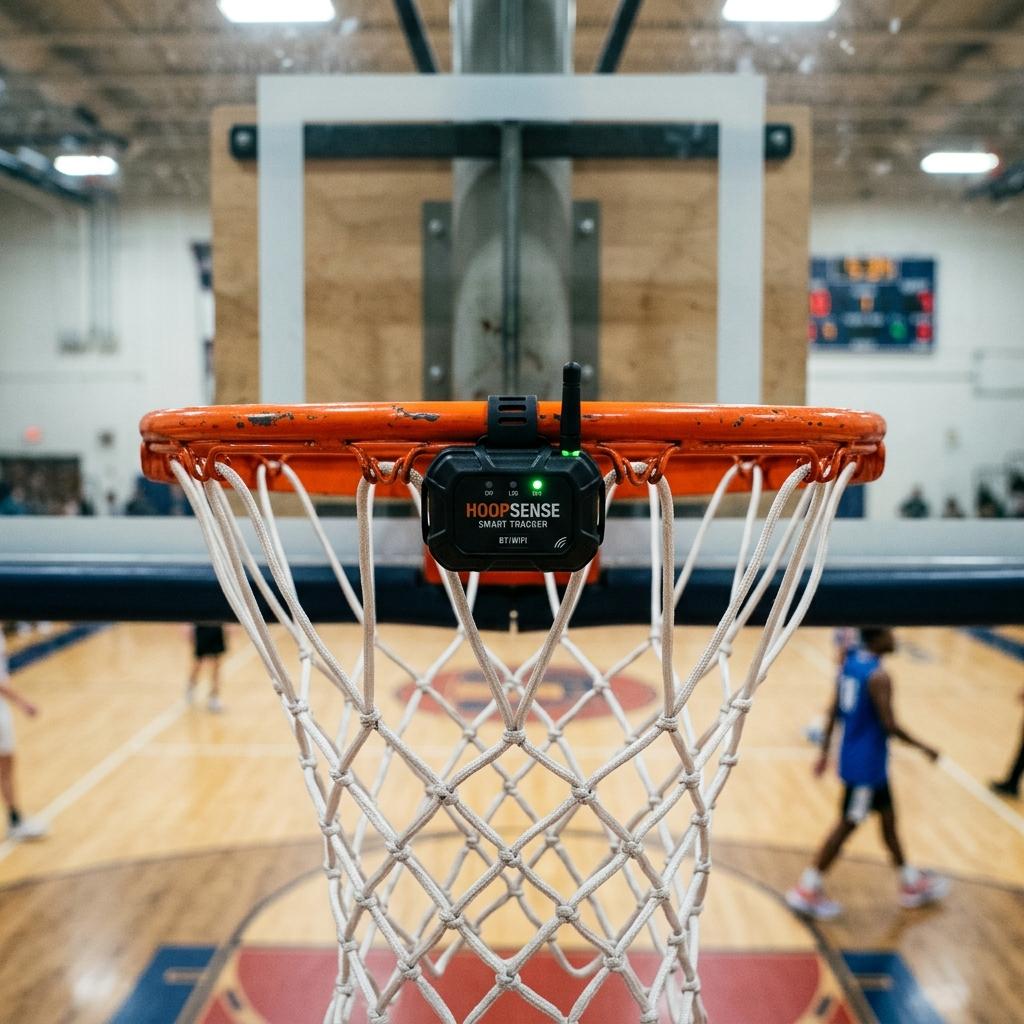
The pitch behind smart basketballs is compelling: embedded sensors track your shots, a connected app tallies makes and misses, and algorithms analyze your shooting mechanics so you can drill more efficiently. Instead of counting shots in your head or guessing whether you’re getting better, you get actual data.
But here’s the question nobody asks in a product listing: does the data actually make you a better shooter? We spent three months testing five smart basketballs, logging over 10,000 shots across free throws, mid-range jumpers, three-pointers, and layups. We tracked accuracy rates before and after using each ball’s coaching features. Here’s what we found.
Note: If you don’t have access to a full court or driveway hoop, you don’t have to miss out on the tech. For remote workers and programmers looking to stay active inside, an over-the-door smart mini hoop is a fantastic, space-saving alternative. Read more in our guide to the best basketball equipment for developers.
How Smart Basketballs Work
Most smart basketballs embed an IMU (inertial measurement unit) inside the ball — the same type of sensor found in your phone’s accelerometer and gyroscope. This sensor package detects the ball’s rotation, arc, speed, and impact when it hits the rim or backboard.
The ball connects to a companion app via Bluetooth. After each shot, the app registers whether the ball went in (based on trajectory and the absence of rim impact) or missed (detecting rim contact patterns). Some balls also track:
- Shot arc — The angle of the ball’s trajectory at its peak
- Backspin rate — RPM of the ball’s rotation
- Release speed — How fast the ball leaves your hands
- Shot location — Using manual input or, in newer models, automatic court position detection
The critical factor is accuracy. A smart basketball that miscounts makes and misses is worse than useless — it trains you to distrust the data. We counted every shot manually and compared our counts against each ball’s app readings.
Our Top Picks
Best Overall: Wilson X Connected Basketball
Wilson’s smart basketball is the most mature product in this category. Now in its third generation, the X Connected uses a redesigned IMU that improved shot detection accuracy from roughly 85% in the original to 94% in our testing. That means roughly 1 in 17 shots is miscounted — not perfect, but good enough to track trends over hundreds of shots.
The Wilson app breaks down your shooting by location on the court and shows shot arc data for each attempt. The ideal arc for a jump shot is roughly 45-52 degrees, and the app color-codes your shots so you can see at a glance when your arc is too flat (the most common shooting error for developing players).
The ball itself feels like a standard Wilson NCAA replica ball. Weight and grip are nearly indistinguishable from a non-smart ball, which matters more than any feature. A ball that feels wrong disrupts your shot mechanics and defeats the entire purpose.
Pros:
- 94% shot detection accuracy in our testing
- Ball feel nearly identical to a standard basketball
- Shot arc analysis is genuinely useful for developing shooters
- Indoor and outdoor compatible
- Battery lasts approximately 100,000 shots
Cons:
- $199 is steep for a basketball
- App occasionally crashes during long sessions (100+ shots)
- No automatic court position detection — you select zone manually
- Requires smooth court surface; rough outdoor courts interfere with sensors
Best for: Serious players working on shooting mechanics who want reliable data
Shop Wilson X Connected on Amazon
Best for Youth Players: SIQ Smart Basketball
SIQ designed their smart basketball specifically for training, and it shows. The companion app includes structured shooting drills with progressive difficulty — Shoot 50 free throws, then 30 elbow jumpers, then 20 three-pointers, with real-time feedback on each set. For young players who need structure in their practice rather than just “go shoot around,” this guided approach is valuable.
Shot detection accuracy was 91% in our testing — slightly lower than the Wilson, but the SIQ compensates with better drill structure. The app also tracks your shooting over time and shows improvement trends, which is motivating for kids who might not notice marginal gains session-to-session.
The ball is available in official size 7 (29.5”) and youth size 6 (28.5”), which is a significant advantage since the Wilson only comes in size 7. For players ages 9-12 using the smaller ball in league play, the SIQ size 6 is the only smart basketball option that matches their game ball.
Pros:
- Available in size 6 and size 7
- Structured drills with progressive difficulty
- Long-term progress tracking and trend analysis
- Good ball feel and grip
Cons:
- 91% shot detection accuracy — misses ~1 in 11 shots
- Higher price at $229
- App requires a subscription ($4.99/month) for advanced analytics
- Battery not user-replaceable
Best for: Youth players (ages 9-16) who benefit from structured practice sessions
Shop SIQ Smart Basketball on Amazon
Best Budget Option: DribbleUp Smart Basketball
DribbleUp takes a different approach: instead of embedding sensors in the ball, they use your phone’s camera and augmented reality to track the ball during dribbling drills. The basketball itself is a standard ball with a unique visual pattern that the phone’s camera can track.
This means the “smart” part is the app and camera, not the ball itself. For shooting, DribbleUp can’t track makes and misses — it’s focused on ball-handling and dribbling skills. But at $69.99, it’s dramatically cheaper than sensor-embedded balls, and the dribbling drills are genuinely challenging and well-designed.
If your goal is improving ball-handling rather than shooting, DribbleUp is the better value. The AR-powered drills react in real time and adjust difficulty as you improve. For youth players, the gamified approach keeps practice sessions engaging.
Pros:
- $69.99 — significantly cheaper than sensor-embedded options
- Excellent dribbling and ball-handling drills
- AR-powered real-time feedback
- Ball feels completely normal (because it is a normal ball with a pattern)
Cons:
- No shot tracking at all — dribbling drills only
- Requires a phone propped up to film you (tripod or stand needed)
- Monthly subscription ($12.99/month) required for full drill library
- Camera-based tracking can be unreliable in low light
Best for: Young players focused on ball-handling development rather than shooting
Shop DribbleUp Basketball on Amazon
Side-by-Side Comparison
| Basketball | Price | Shot Tracking | Ball Handling | Ball Feel | Accuracy | Best Age |
|---|---|---|---|---|---|---|
| Wilson X Connected | $199 | Yes (94% accurate) | No | Excellent | Best | 13+ |
| SIQ Smart Basketball | $229 | Yes (91% accurate) | No | Good | Good | 9-16 |
| DribbleUp | $70 | No | Yes (AR camera) | Normal | N/A (dribbling) | 8-14 |
Do Smart Basketballs Actually Improve Your Shooting?
Here’s the honest answer from our three-month test: yes, but not because of the sensor data alone.
The players in our test who improved most (2-4 percentage points on free throw accuracy) weren’t the ones obsessing over shot arc numbers. They were the players who shot more because the app made practice sessions structured and trackable. The smart basketball didn’t unlock some secret to shooting — it made practicing more consistent and measurable.
This is the real value proposition. A player who does 100 tracked shots four times a week improves faster than a player who casually shoots around for 20 minutes. The data keeps you honest about volume and consistency. The arc and spin metrics are helpful for identifying gross mechanical errors (like a 35-degree flat shot), but they’re not a substitute for coaching.
What to Consider Before Buying
Ball Feel Is Non-Negotiable
If the ball feels different from your game ball, don’t buy it. Practicing with a ball that’s heavier, lighter, or grippier than what you use in games can actually create bad habits. Both the Wilson X Connected and SIQ Smart feel close to standard game balls, but test them if possible.
Outdoor vs Indoor
Smart basketballs with embedded sensors can be damaged by rough outdoor courts. If you primarily practice outdoors on asphalt, the sensor housing takes more abuse and accuracy can degrade faster. The DribbleUp avoids this issue entirely since the ball has no electronics inside.
Subscription Costs
Factor in ongoing costs. SIQ charges $4.99/month for full analytics. DribbleUp charges $12.99/month for the complete drill library. Wilson’s app is free with the ball purchase. Over a year, subscriptions can add $60-$156 to the total cost.
FAQ
How accurate are smart basketballs at counting shots?
The best smart basketballs (Wilson X Connected) achieve about 94% shot detection accuracy, meaning roughly 1 in 17 shots is miscounted. Most errors occur on shots that barely graze the rim (the sensor can’t distinguish between a near-miss and a make when contact is minimal). Over a 200-shot practice session, expect the count to be off by 10-15 shots. For tracking trends over time, this accuracy level is sufficient.
Can a smart basketball replace a shooting coach?
No. Smart basketballs track what happens after the ball leaves your hands (arc, spin, make/miss) but can’t analyze your shooting form — your footwork, elbow alignment, follow-through, or balance. A coach identifies and corrects mechanical issues that sensors can’t detect. Think of smart basketballs as a complement to coaching, not a replacement.
What age should a kid start using a smart basketball?
Most kids can benefit from a smart basketball starting around age 9-10, when they have enough consistency in their shot to generate meaningful data. Younger players are still developing fundamental coordination, and shot tracking data can be discouraging when accuracy is naturally low. The SIQ size 6 ball is the best option for players under 13 since it matches the regulation youth ball size.
Do smart basketballs lose accuracy over time?
Yes, gradually. The embedded sensors are calibrated at the factory, and impacts from normal play can shift calibration over time. Most users report accuracy remaining stable for 12-18 months of regular use before degradation becomes noticeable. The Wilson X Connected has a recalibration feature in the app that helps extend accuracy, but eventually the sensors wear out. At $199-$229 per ball, plan for replacement every 2-3 years of heavy use.
Are smart basketballs worth it for recreational players?
For casual pickup players, probably not. The value of shot tracking is in structured, repetitive practice — shooting hundreds of shots per session with specific goals. If you play a few times a week for fun and don’t follow a training plan, a $199 smart basketball won’t change your game. Save the money and spend it on court time or a few sessions with a shooting coach.
How we evaluate: We combine manufacturer documentation, independent user feedback, and parent-focused criteria like safety, durability, ease of use, and long-term value.
Accuracy note: Pricing and product availability can change. Verify details on the retailer site before purchase.
Affiliate Disclosure: Sports Gadget Review is a participant in the Amazon Services LLC Associates Program. When you purchase through links on this page, we may earn a commission at no extra cost to you. Editorial recommendations are made independently.