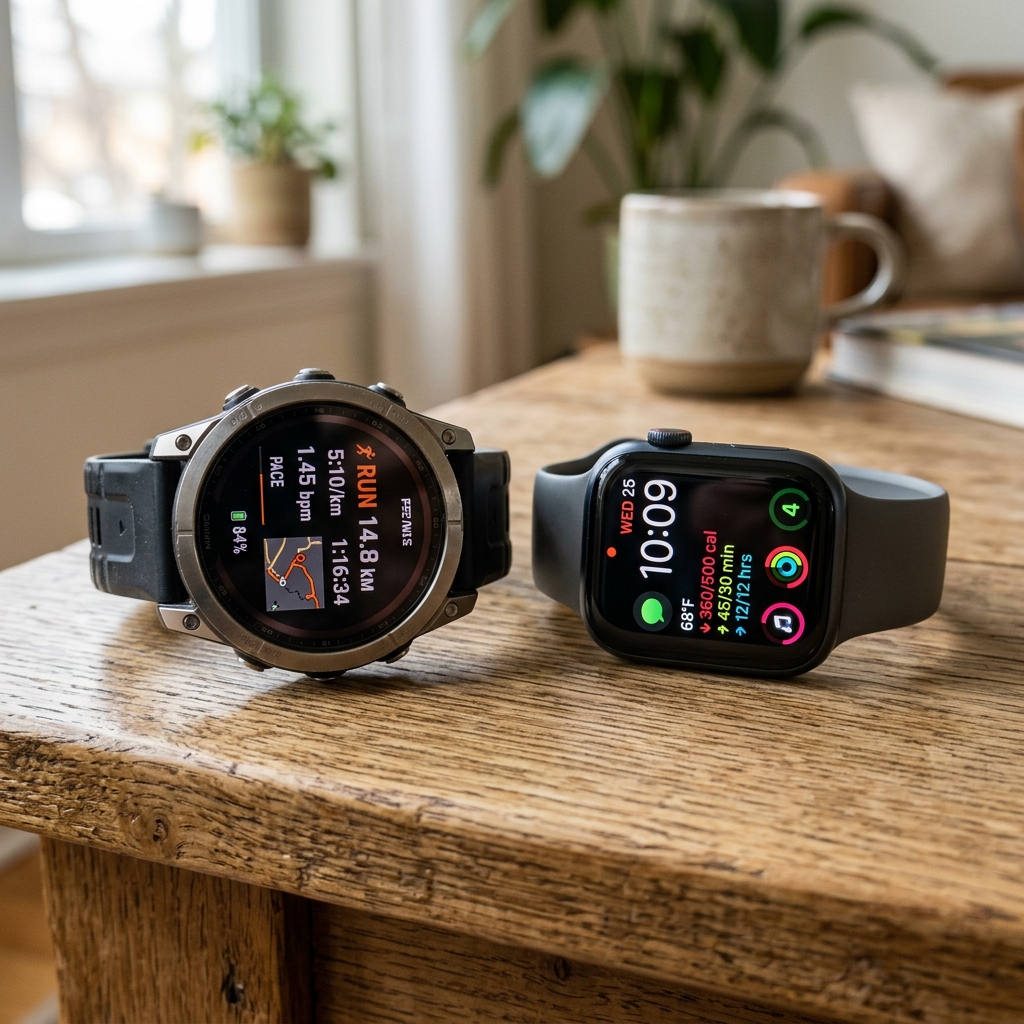
If you are training for a 5K, a marathon, or a trail ultra, you need to track your runs. But choosing between a dedicated running watch and a general-purpose smartwatch is a choice between two different design philosophies.
A dedicated running watch (like a Garmin Forerunner or COROS Pace) prioritizes battery life, outdoor screen visibility, physical buttons, and deep physiological recovery metrics. A smartwatch (like an Apple Watch or Samsung Galaxy Watch) prioritizes cellular connectivity, high-resolution AMOLED displays, lifestyle apps, and touch interaction.
We spent three months running with the leading models from both categories, tracking over 300 miles of city streets and wooded trails. Here is how they compare across the metrics that actually matter.
For a deeper dive into specific models, check out our Garmin vs Apple Watch runners comparison or review our picks for GPS watches under $200.
The Core Trade-offs: Feature Comparison
Here is how the two categories stack up across critical performance variables.
| Feature Category | Dedicated Running Watch (e.g., Garmin Forerunner 265) | General Smartwatch (e.g., Apple Watch Series 9) |
|---|---|---|
| Battery Life (GPS active) | 14 to 20 hours | 5 to 7 hours |
| Battery Life (Daily wear) | 10 to 14 days | 18 to 36 hours |
| GPS Tracking Mode | Dual-frequency (always available on mid-tier+) | Single or dual (drains battery rapidly) |
| Screen Type | Transflective MIP or battery-optimized AMOLED | High-brightness AMOLED |
| Controls | 5 physical buttons (ideal for sweat/gloves) | Touchscreen + digital crown |
| Training Metrics | Training load, recovery time, HRV status, race predictor | Heart rate zones, basic running power |
| Smart Features | Basic notifications, offline music (some models) | LTE cellular, app store, replies, voice assistant |
Technical Performance Testing
1. GPS Accuracy: Dual-Frequency vs Single-Band
GPS accuracy is determined by how well the watch handles signal interference from tall buildings, trees, and cliffs.
Dedicated running watches like the COROS Pace 3 and Garmin Forerunner 265 feature dual-frequency (L1/L5) GPS tracking as a standard option. In our testing through downtown urban canyons, these watches maintained a clean tracking line within 5 feet of our actual path.
General smartwatches, particularly base models, often rely on single-band GPS to conserve battery. In the same urban canyon test, the Apple Watch Series 9 drifted up to 40 feet off course, showing us running through buildings and cutting corners. This error accumulated over a 10-mile run, resulting in a recorded distance that was 0.3 miles too short, throwing off our pacing metrics.
2. Battery Endurance: The Weekly Charging Factor
Battery life is the most significant differentiator. A dedicated running watch is designed for ultra-endurance events.
For example, the COROS Pace 3 provides up to 38 hours of continuous GPS tracking, meaning you can run a 100-mile ultra-marathon on a single charge. In daily watch mode, it requires charging only once every two weeks.
An Apple Watch Ultra 2 represents the best battery life in the smartwatch class, surviving up to 12 hours of continuous GPS tracking or 36 hours of normal daily use. However, standard smartwatches must be charged daily. If you plan to track your sleep and run first thing in the morning, managing a daily charging schedule becomes a persistent point of friction.
Detailed Model Reviews
1. Garmin Forerunner 265 — Best Dedicated Running Watch
 Best Dedicated Watch
 Garmin
Garmin Forerunner 265
Advanced training load metrics, dual-frequency GPS, and a vibrant AMOLED display with physical buttons
The Garmin Forerunner 265 is the benchmark for dedicated running watches. It features a bright AMOLED display that is easy to read in direct sunlight, combined with a five-button physical layout that ensures reliable operation when your hands are sweaty or you are wearing gloves.
Its standout feature is Garmin’s suite of training metrics. The watch tracks your HRV (Heart Rate Variability) status, sleep history, and recent training history to generate a daily “Training Readiness” score. This tells you whether your body is ready for a hard speed workout or if you should take an easy recovery run. It also features dual-frequency GPS, offline music storage, and Garmin Pay.
2. Apple Watch Ultra 2 — Best Smartwatch for Runners
 Best Premium Smartwatch
 Apple
Apple Watch Ultra 2
Rugged titanium construction, dual-frequency GPS, and up to 36 hours of battery life with cellular connectivity
The Apple Watch Ultra 2 bridges the gap between lifestyle smartwatch and rugged sports watch. Constructed with a titanium case and sapphire crystal face, it is built to survive trail scrapes and impacts. It includes a dedicated “Action Button” that can be customized to start a run workout instantly, providing a tactile control option that standard Apple Watches lack.
Its dual-frequency GPS performance matches Garmin’s top-tier watches, and the screen can reach 3,000 nits of brightness, making it highly readable in bright outdoor settings. With LTE cellular capability, you can stream music, receive emergency calls, and use maps without carrying your phone. The main draw is the high price point and the weight; at 61 grams (without strap), it is twice as heavy as the Garmin Forerunner 265.
Frequently Asked Questions
Can I run without my phone using a smartwatch?
Yes. Smartwatches with LTE cellular capability (like the Apple Watch LTE models) can track your run, stream music, and make calls without your phone. Dedicated running watches with music capabilities (like the Garmin Forerunner 265 Music or COROS Pace 3) can store music files directly on the watch and connect to Bluetooth headphones, but they cannot make phone calls or stream live without a phone connection.
How accurate are wrist-based heart rate monitors during runs?
Wrist-based optical sensors are highly accurate during steady-state runs, tracking within 2-3 BPM of a chest strap. However, they struggle with high-intensity interval training (HIIT) or short sprints due to “sensor lag” caused by rapid changes in blood flow and the watch moving on your wrist. For interval training, pairing your watch with a chest strap is recommended.
Why do running watches use physical buttons instead of touchscreens?
Touchscreens fail in wet conditions. Sweat, rain, and water splashes simulate finger touches on capacitive screens, which can pause your workout or change screens mid-run. Physical buttons provide reliable, tactile feedback that works in all weather conditions, even when wearing heavy winter gloves.
What is Heart Rate Variability (HRV) and why does it matter?
HRV measures the variation in time between consecutive heartbeats, which is controlled by your autonomic nervous system. A higher HRV indicates your body is recovered and adapting well to training stress. A lower HRV suggests fatigue, overtraining, or oncoming illness. Most dedicated running watches track HRV overnight to calculate your recovery status.
Is the Garmin Forerunner 265 worth the upgrade over the COROS Pace 3?
The Garmin Forerunner 265 features a premium AMOLED screen and offers deeper training readiness metrics and offline music integration. The COROS Pace 3 is lighter, costs half as much, and has superior battery life (17 days vs 13 days). For budget-focused runners who only care about tracking data, the COROS Pace 3 is the better value.
How we evaluate: We combine hands-on use (when available), manufacturer documentation, independent user feedback, and parent-focused criteria like safety, durability, ease of use, and long-term value.
Accuracy note: Pricing and product availability can change. Verify details on the retailer site before purchase.
Affiliate Disclosure: Sports Gadget Review is a participant in the Amazon Services LLC Associates Program. When you purchase through links on this page, we may earn a commission at no extra cost to you. Editorial recommendations are made independently.